Claude Mythos: The AI Model That's Too Powerful to Release (And What That Means for Every Developer)
What is Claude Mythos? Discover the AI model too powerful for public release and the implications for developers, security, and the future of software.


Table of contents
Anthropic's most capable model yet is not something you can sign up to use. Anthropic announced it, then deliberately held it back from open release. How the company handled that decision tells every engineering leader something important about hiring, security, and the future of software teams.
| Metric | Result | Context |
|---|---|---|
| SWE-bench Verified | 93.9% | vs ~35% for top human engineers |
| USAMO 2026 (math) | 97.6% | top 1% human performance |
| CyberGym (security) | 83.1% | real-world vulnerability tasks |
| Access | Gated | Limited to Project Glasswing partners on Vertex AI |
What is Claude Mythos?
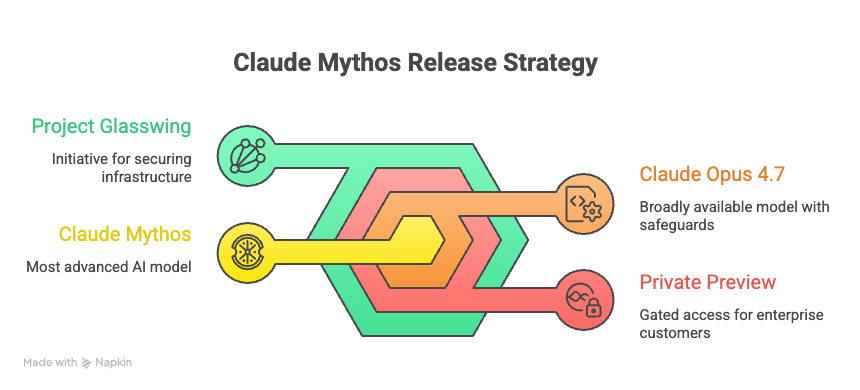
On April 7, 2026, Anthropic announced Claude Mythos alongside a roughly 240-page system card and a security program called Project Glasswing. It did not release the model openly. Anthropic's own system card describes Mythos as a "step change" in AI capability: a model that does not just assist developers, but operates at a level that blurs the line between assistant and engineer.
Access is tightly controlled through Project Glasswing on Google Cloud's Vertex AI, limited to a small set of vetted partners. Even enterprise partners have restricted access. That level of caution, from a company that has shipped capable models publicly before, is itself a signal worth taking seriously.
This is the first time a lab has publicly stated that a model is being held back from open release because it is too capable, not just because it needs more safety work.
The benchmark reality
Numbers like SWE-bench and USAMO are not abstract. SWE-bench Verified measures a model's ability to resolve real GitHub issues, the kind of debugging and implementation work that fills senior engineers' calendars. According to Anthropic's Mythos system card, here is how Mythos compares:
| Benchmark | Mythos | Claude Opus 4.6 | Human Expert |
|---|---|---|---|
| SWE-bench Verified (coding) | 93.9% | 80.8% | ~35% |
| USAMO 2026 (advanced math) | 97.6% | Not reported | Top 1% globally |
| CyberGym (cybersecurity) | 83.1% | Not reported | Varies |
| Agentic task completion | Significantly above prior models | Baseline | – |
Human Expert scores reflect top-percentile performers, not averages.
Why cybersecurity is the central controversy
Mythos is genuinely exceptional at identifying and exploiting software vulnerabilities, not in theory, but executing end-to-end attack chains from natural language instructions. On CyberGym, a benchmark of real-world security tasks, Anthropic's system card reports Mythos scoring 83.1%, well above prior models. Anthropic's red-team testing found it can surface zero-day vulnerabilities in complex codebases faster than earlier models, and that it meaningfully lowers the skill floor for sophisticated exploits.
This creates a dual-use paradox that no prior model has forced into the open so sharply:
For defenders: Security teams can audit codebases at unprecedented speed, find vulnerabilities before attackers do, and automate remediation. CrowdStrike is a Project Glasswing founding member.
For attackers: The same capabilities that make it brilliant at finding bugs make it dangerous in the wrong hands. Reconnaissance, exploitation, lateral movement, all from natural language.
What Mythos actually does
Strip away the security controversy and Mythos is the most capable autonomous software engineering model ever built. In practice, that means:
End-to-end development: Given a high-level product requirement, it can architect, write, test, and debug a working implementation across multiple files and services. Think less Copilot and more like a senior engineer who never sleeps.
Long-horizon reasoning: Where earlier models lose coherence on complex multi-step problems, Mythos maintains context and logical consistency across extended reasoning chains, critical for system design, refactoring legacy codebases, or building complex data pipelines.
Autonomous agentic operation: Given a goal and tool access (APIs, terminals, databases), it executes autonomously without hand-holding at each step, a fundamental architectural difference from prior Claude models.
Multimodal engineering: The model can process code, system architecture diagrams, logs, and documentation simultaneously, meaning it can diagnose infrastructure issues by reading a dashboard screenshot alongside error logs.
The real threat is not hackers, it's complacency
Here's the uncomfortable truth: the biggest risk Mythos poses to software teams is not a malicious attacker using it. It's engineering leaders who don't adapt to it.
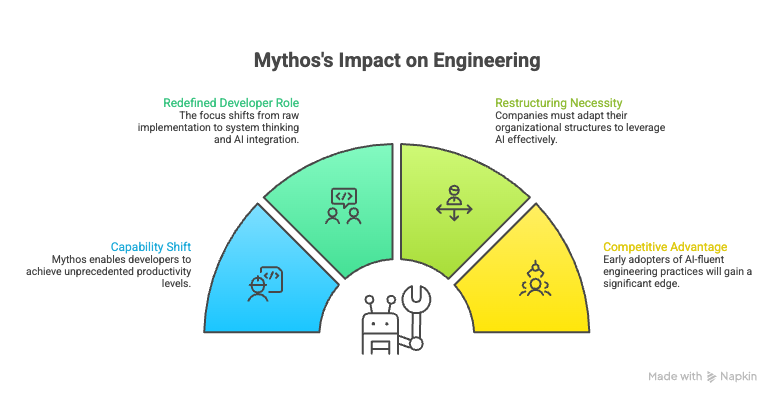
A single skilled developer with access to Mythos can now deliver what previously required a small team. That's not speculation. It's the direct implication of SWE-bench scores that exceed most senior engineers' practical output. The companies that recognise this and restructure their engineering orgs around it will have a decisive productivity advantage. The ones that don't will be running legacy team structures against leaner, Mythos-augmented competitors.
The premium now sits on system thinking, product judgment, and the ability to direct AI output at scale, not raw implementation speed. That's a different profile than what most hiring playbooks are built for.
What engineering leaders should do right now
You don't have access to Mythos today. But its existence is already reshaping what forward-thinking teams should be building toward:
Audit AI fluency: If your developers aren't already operating with frontier coding models as daily tools, you have a capability gap that Mythos will make costly.
Redefine seniority: Senior engineers in a Mythos era define, scope, and validate what AI systems build. Your hiring criteria need to reflect this shift.
Harden security now: AI-assisted vulnerability discovery is already live with earlier models. Your codebase needs auditing against a threat model that includes AI-powered attackers.
Hire for adaptability: Smaller teams with higher AI fluency will outcompete larger teams with lower fluency. Prioritise quality and adaptability over headcount.
The talent market bifurcation
The supply of "good enough" developers is about to increase dramatically, while the premium on exceptional ones will skyrocket. Mythos-class models mean a mediocre developer augmented by AI can produce output comparable to a solid mid-level engineer from three years ago, compressing value in the middle of the market.
At the same time, the complexity of problems elite engineers can tackle expands dramatically. The talent market will bifurcate: commoditised implementation on one end, premium architectural and AI-direction skills on the other. Access to a powerful model doesn't make a weak engineer a strong one. It amplifies whatever judgment and capability they already have.
In a Mythos era, the constraint is not access to the model. It is judgment: knowing what to build, scoping it correctly, and validating what the AI produces. That is exactly what rigorous vetting screens for. RocketDevs evaluates every developer over 6–8 hours and places only the top 2–5%, so the engineers you hire can direct AI output instead of being commoditised by it.
Frequently asked questions
What is Claude Mythos?
How does Claude Mythos compare to Claude Opus 4.6 on SWE-bench?
Why has Anthropic restricted access to Claude Mythos?
What does Claude Mythos mean for hiring developers?

Written by
Joy Atuzie
Growth Marketing Manager
I live at the intersection of search, content, and paid media. The work I do turns underperforming pages into traffic magnets, cold audiences into warm leads, and scattered marketing efforts into systems that actually compound over time.
More from our blog
Continue exploring insights and stories from RocketDevs