Why your AI coding agent writes too much code: the viral "lazy senior developer" fix
A viral tool called Ponytail forces AI agents to think like a lazy senior developer before writing code, and why that judgment still has to be hired for.


Table of contents
AI coding agents overbuild by default, piling up technical debt. Here's why it happens, the viral "lazy senior developer" fix, and who to hire to control it.
AI coding agents often write more code than necessary because they are never told when to stop. By default, they aim to produce a complete-looking solution. This often means creating extra files, adding unnecessary features, and introducing dependencies the task does not need.
A viral tool called Ponytail tackles this problem. It encourages AI to think like a "lazy senior developer." Instead of writing more code, it writes only what is needed. The bigger lesson is clear: in the age of AI good judgement is becoming the most valuable skill.
In this article
- What is Ponytail, and why did it get tens of thousands of stars so fast?
- Why do AI coding agents write too much code by default?
- How a "laziness layer" actually changes what an agent builds
- What does AI overbuild actually cost?
- What this means for hiring: the skill is judgment, not keystrokes
- How RocketDevs vets for the judgment that governs AI agents
- FAQ
What is Ponytail, and why did it get tens of thousands of stars so fast?
In the words of its own GitHub repository, Ponytail is a small skill harness that makes an AI coding agent "think like the laziest senior developer in the room." The tagline for the product is simply "the best code you never wrote." Ponytail launched in June 2026 and went viral very quickly. Within days it accumulated 38.5k GitHub stars and has kept climbing. In addition, according to a write-up by Tosin Akinosho at Decision Crafters, the product has sparked viral discussions on X, Reddit, and Hacker News.
Ponytail has resonated so well with the public because it names a problem every founder shipping with AI has felt but has struggled to articulate. The agent is productive and the codebase keeps growing, yet somehow everything feels heavier and more fragile than the work justifies. Ponytail doesn't make the model smarter, it changes the order in which the agent decides what to do, which cuts the output dramatically.
Why do AI coding agents write too much code by default?
AI coding agents tend to overbuild because they are optimised to produce confident, complete-looking solutions rather than the smallest solution that works. Unless they are explicitly told to question whether new code is needed at all, they default to writing more.
This is often referred to as the "80% problem." As described in Augment Code's guide, AI systems can usually generate the first 80% of a working solution quite well. But the remaining 20%—production readiness, edge cases, and architectural consistency—is where things break down. This happens because agents lack persistent context and proper verification. Early results can look impressive, but issues often appear later in real-world use.
A related issue is code reuse. Instead of using existing, tested logic in a codebase, agents often rewrite similar functionality from scratch. This leads to duplication and inconsistency.
As Addy Osmani explains in "The 80% Problem in Agentic Coding": "The danger isn't that the agent fails. It's that it succeeds so confidently in the wrong direction that you stop checking the compass."
Ultimately, overbuilding is not just a bug to be fixed in future models. It is a predictable outcome of how these systems are prompted and rewarded, which is why improvements at the prompt level can make a meaningful difference.
How a "laziness layer" actually changes what an agent builds
A laziness layer works by changing how an AI agent decides what to do before it writes any code. It doesn't modify the underlying model. Instead, it reshapes the decision process inside the context window.
This is why the approach works across different models and systems: it's prompt engineering, not fine-tuning.
In the case of Ponytail, the system adds a fixed decision ladder that the agent must follow before generating code. According to the project's README, the steps are:
- Does this need to exist at all (YAGNI)?
- Does it already exist in the codebase?
- Can the standard library handle it?
- Is there a built-in platform feature?
- Is there an existing dependency?
- Can it be done in one line?
- If not, what is the smallest possible implementation?
The key idea is that the agent must go through these checks first. It is encouraged to be "lazy" about writing solutions, but not about understanding the problem.
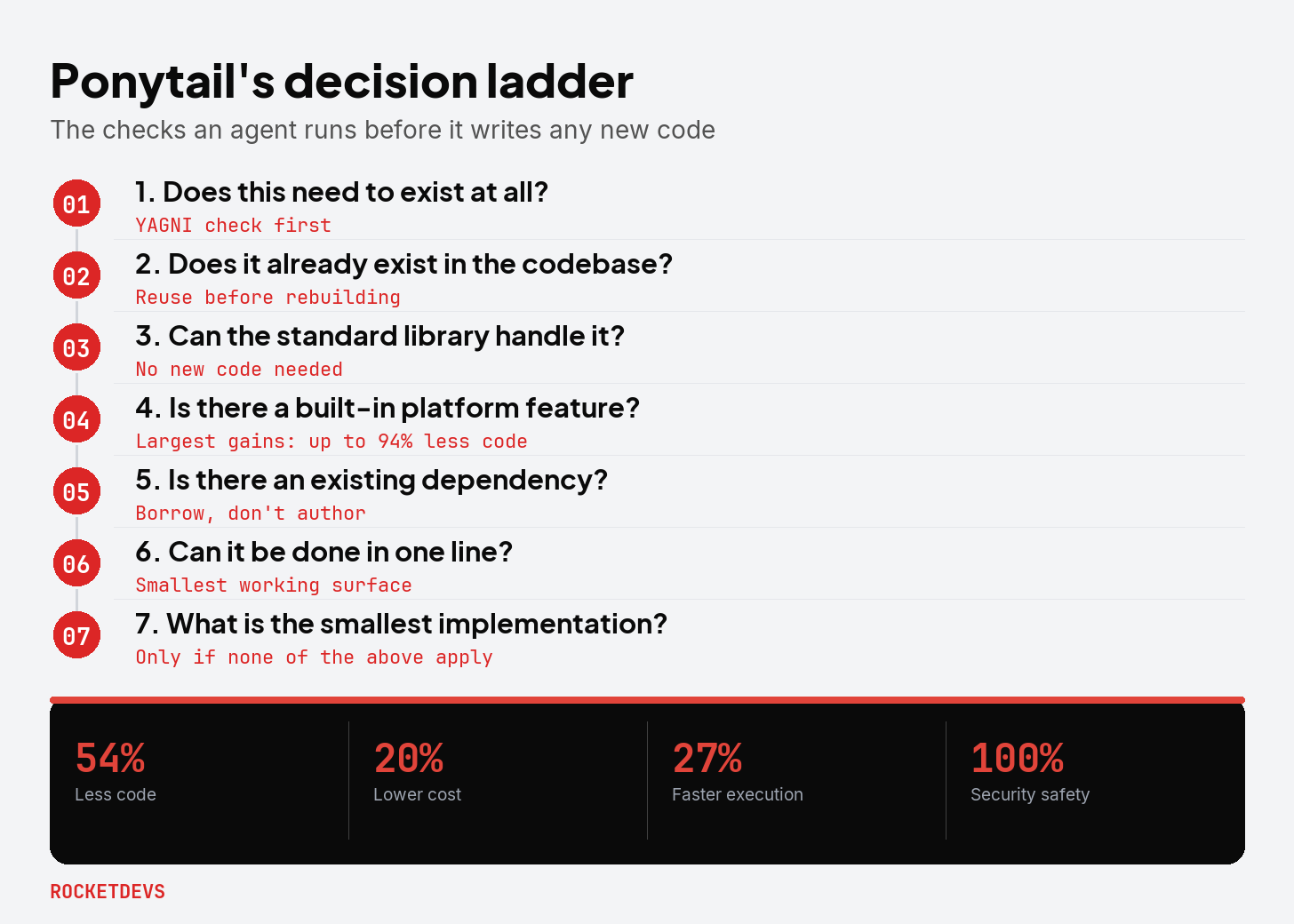
Benchmarks reported by the project suggest meaningful changes in output. On tests run against the tiangolo/full-stack-fastapi-template repository using Haiku 4.5 across 12 feature tasks (n=4 runs), results showed around 54% less code, 20% lower cost, and 27% faster execution, while still achieving 100% safety on security-related tasks (20/20). In a simpler "just write one-liners" setup, safety dropped to 95%.
The largest gains—up to 94%—occur when a native platform feature replaces a custom implementation, such as using a built-in component instead of hand-coding one. On problems where custom code is unavoidable, performance converges.
In short, the savings come from better architectural choices, not from simply writing less.
This idea is part of a broader trend. Tools like loop-engineering by Cobus Greyling provide patterns, starter kits, and CLI tools for managing agent workflows over time, including auditing and cost estimation. Meanwhile, dox by agent0ai uses self-updating "AGENTS.md" files so the model reads project rules before making changes.
Different implementations, same principle: AI agents need a governance layer, because left on their own, they don't reliably know when to stop.
What does AI overbuild actually cost?
AI overbuilding has a real, long-term cost. It creates more bugs that slip into production and leads to repeated chunks of code scattered across a system. The problem is that this cost doesn't show up immediately when the code is generated. It shows up later—during code reviews, maintenance work, and system failures.
Large-scale research supports this. A study on AI-generated code, "Debt Behind the AI Boom" (Liu et al., arXiv), analysed over 300,000 AI-written commits across thousands of GitHub repositories. It found that the number of AI-related issues left in codebases grew rapidly—from only a few hundred in early 2025 to over 110,000 by early 2026. It also estimated that around 24% of these issues still existed in active code, meaning they were never properly fixed. In other words, a significant portion of AI-generated problems remain in production systems.
Another issue is code duplication. Research from GitClear (2025), based on hundreds of millions of lines of code changes, found that copy-pasted code increased from 8.3% to 12.3%. For the first time, more code was being duplicated than properly refactored. This matters because duplicated code means more places that need updating when something changes, which makes systems harder to maintain and more prone to error.
Even the productivity gains are not as clear as they seem. A study by METR found that experienced developers actually took about 19% longer to complete tasks when using AI tools, even though they believed they were working about 20% faster. This gap between perception and reality matters: teams feel more productive because they are producing more code, but that extra code often creates more work for others later.
In short, AI overbuilding can make teams look faster in the short term, while quietly increasing the amount of maintenance, debugging, and cleanup required over time.
What this means for hiring: the skill is judgement, not typing
When code generation becomes cheap and fast, the real constraint shifts. It's no longer how quickly someone can write code—it's how well they can decide what code should exist in the first place. That decision-making ability is a real skill, and it can be assessed when hiring.
The most valuable engineers today are not the fastest coders. They are the ones who can review AI-generated output and confidently decide what to remove, what to keep, and what to reuse. In other words, they act as editors and decision-makers, not just builders.
This is also what tools like Ponytail are trying to support. By adding structured decision steps, they encourage both the agent—and the engineer overseeing it—to pause and ask whether a piece of code is even necessary. But no tool can fully replace human judgment. An AI agent cannot reliably evaluate system architecture, spot flawed assumptions with confidence, or weigh whether a feature is worth its long-term maintenance cost. Those decisions still require experienced engineers.
Research like the METR study highlights another issue: teams often feel like AI is making them faster, even when it actually slows them down. This makes judgment even more important, because you cannot rely on intuition alone to tell whether AI is helping or adding unnecessary complexity.
For founders and hiring managers, this changes the core question. You are no longer just hiring someone to produce code—you are hiring someone who can guide, constrain, and supervise AI systems. In effect, you are hiring the "governance layer" that AI does not have on its own.
This is a skill that can be tested. Strong hiring processes should evaluate whether a candidate can reduce unnecessary complexity, question overbuilt solutions, and validate AI output before it reaches production.
Ultimately, as software development shifts toward AI-assisted workflows, engineers become less like builders and more like conductors. And in that world, the ability to conduct—rather than simply produce—is the real job.
How RocketDevs vets for the judgement that governs AI agents
RocketDevs focuses on one core idea: good AI-assisted engineering depends on human judgment, not just coding ability. Because of this, the vetting process is designed to test how developers think, not just what they can produce.
Each applicant goes through 6-8 hours of evaluation. The goal is to see how they make decisions: what they choose to delete, what they reuse, and when they challenge an approach instead of accepting it. In other words, it tests whether an engineer can act as a filter for AI-generated code, not just a producer of more code.
This process is highly selective, with a rejection rate above 98%. In 2025, for example, only 223 out of 11,422 candidates assessed were accepted, about 1.95%, and the current cohort's acceptance rate sits at Top 2%.
The important point is not the exact numbers, but what they measure. The process is designed to identify engineers who can govern AI output—people who know when to simplify, when to reuse existing code, and when to push back on unnecessary complexity. This is the human layer that sits above AI systems, and it cannot be replaced by prompts or tools alone.
For teams building with AI agents, the main challenge is often that codebases become heavier over time. The solution is not more tooling, but stronger engineering judgment—people who can keep AI output under control and ensure only necessary code makes it into production.
In short, RocketDevs positions itself to hire engineers who can manage and constrain AI-generated code effectively, focusing on judgment as the key skill in modern software development.
If you are building with AI agents and feeling the codebase get heavier, the fix is not another tool on top of the tools. It is an engineer who governs the output. Hire from the Top 2% of developers, vetted over 6-8 hours each. Pricing starts at $9.99/hr for an Associate, $21.99/hr for Mid-senior, and $30.99/hr for a Senior developer, backed by a 14-day money-back trial, 100% honoured. Hire vetted AI and ML developers who can keep agent output in check. Elite Talent. Honest Price.
FAQ
Why do AI coding agents write too much code?
AI coding agents often write too much code because they are designed to be helpful and complete rather than minimal. They tend to fill in the gaps when instructions are unclear, which leads them to add extra features, structure, and error handling even when it isn't needed. They also don't naturally understand the long-term cost of extra code or what already exists in a project, so they often rewrite or expand instead of reusing. As a result, they default to overbuilding because it feels safer and more correct in the moment.
What is Ponytail and does it actually reduce code?
Ponytail is a prompt-based "laziness layer" for AI coding agents. Instead of changing the model itself, it forces the agent to follow a decision checklist before writing code—starting with questions like "does this need to exist at all?" and "can we reuse something already built?" The goal is to reduce unnecessary code by pushing the agent toward reuse and simplicity. In reported benchmarks, this approach reduces code volume and cost in many cases, mainly by avoiding new implementations when existing or built-in solutions already work.
Does AI-generated code create technical debt?
Yes, it can. AI-generated code often increases technical debt when it duplicates existing logic, adds unnecessary layers, or introduces subtle bugs that are harder to trace later. While it can speed up development in the short term, the long-term cost shows up in maintenance, debugging, and cleanup. The main risk is not just errors, but extra code that didn't need to exist in the first place and still has to be maintained.
How do you hire engineers who can manage AI coding agents?
You hire for judgment, not just coding speed. The key skill is the ability to review AI output and decide what to keep, remove, or simplify. Strong candidates can question overbuilt solutions, reuse existing code, and prevent unnecessary complexity from entering production. Good hiring processes test decision-making and trade-offs, not just whether someone can produce working code.
Is more AI-generated code a good measure of productivity?
Not reliably. More code doesn't necessarily mean more progress—it can also mean duplication, overengineering, or extra maintenance work later. In some cases, AI tools make developers feel faster while actually increasing total work. A better measure of productivity is whether the final system is simple, correct, and maintainable, not how much code was produced.
Sources
- DietrichGebert/ponytail, repository and README
- DietrichGebert/ponytail, agentic benchmark (2026-06-18)
- Tosin Akinosho, Decision Crafters, "Ponytail: AI agents writing less code like senior devs"
- Augment Code, "The 80% problem: why AI agents ship fast but create hidden technical debt"
- Addy Osmani, "The 80% problem in agentic coding"
- Liu, Widyasari, Zhao, Irsan, Lo, "Debt Behind the AI Boom: A Large-Scale Empirical Study of AI-Generated Code in the Wild" (arXiv)
- GitClear, "AI Copilot Code Quality: 2025 research"
- METR, "Measuring the impact of early-2025 AI on experienced open-source developer productivity"
- cobusgreyling/loop-engineering
- agent0ai/dox
James Hitch, COO at RocketDevs Last updated: 2026-07-06

Written by
James Hitch
COO
James Hitch is the COO of RocketDevs, where he runs sales, recruiting, and the vetting operation that accepts only the top 2–3% of developer applicants. He cares about putting accessible, elite engineering talent within reach of founders and startups worldwide, at a fair price. He writes about technical hiring, building AI-native engineering teams, and how startups can access elite developers affordably.
More from our blog
Continue exploring insights and stories from RocketDevs