What Is a Founding Engineer? The 2026 Guide to the Role, and How to Hire One.
A founding engineer is a startup's first technical hire. Here's what the role does in 2026, how it differs from a CTO, what to pay, and how to vet one.


Table of contents
A founding engineer is a startup's first, or one of its first, technical hires. They turn an idea into a working product, build the initial technical foundation, and make many of the early engineering decisions that influence how the company grows. Unlike a CTO, whose primary responsibility is leading engineering teams and setting long-term technical strategy, a founding engineer is a hands-on builder focused on getting the product into users' hands.
The role has also evolved. As AI coding tools become a standard part of software development, founding engineers spend less time writing every line of code themselves and more time directing AI, reviewing its output, and making the architectural decisions that AI cannot. Google's CEO, Sundar Pichai, has said that AI now generates around 75% of new code at Google, making engineering judgment more valuable than ever.
This guide explains what a founding engineer does, how the role differs from a CTO, what founders should expect to pay in salary and equity, and how to hire the right person for one of the most important early hires a startup can make.
In This Article:
- What is a founding engineer, and what it isn't
- Founding engineer vs CTO: which one you actually need first
- What the job really is in 2026
- Equity, pay and what is normal for the role
- How to vet a founding engineer, even if you can't read code
- How RocketDevs helps you hire a vetted founding engineer
- Conclusion
- FAQ
What is a Founding Engineer?
A founding engineer is a startup's first, or one of its first, technical hires. Their job is to turn an idea into a working product while building the technical foundation the company will rely on as it grows. As one of the earliest employees, they have a significant influence on the product, the codebase, and the company's engineering culture. John Kim, co-founder of Paraform, describes founding engineers as playing "a crucial role in shaping the company's technological foundation."
Unlike engineers who focus on a single area, founding engineers work across the entire technology stack. A founding engineer's role is to:
- build frontend and backend systems;
- manage infrastructure;
- solve technical problems wherever they arise;
- and make the practical trade-offs needed to launch quickly.
They take responsibility for early technical decisions, knowing those choices will shape the product long after the first release.
A founding engineer is not a manager or a narrow specialist. They are a hands-on builder who thrives in uncertainty, works independently, and takes ownership from idea to implementation. While they are typically employees rather than co-founders, they often receive meaningful equity and work closely with the founding team, giving them a high level of influence over the company's early direction.
If you're deciding whether you need a founding engineer or a technical co-founder, remember that they serve different purposes. A founding engineer joins as an early employee to build the product, while a technical co-founder shares ownership of the business and helps shape both the company's technical and strategic direction.
Founding Engineer vs CTO: What is the Difference, and Which do you need first?
The difference between a founding engineer and a CTO comes down to their responsibilities and the stage of the company, not seniority. A founding engineer is a hands-on builder responsible for turning an idea into a working product. A CTO, on the other hand, focuses on building the engineering organization, setting the company's long-term technical strategy, and leading technical teams as the business grows.
For most seed-stage startups, a founding engineer should come first. At this stage, the biggest challenge is building and launching a product, not managing an engineering department. As the company scales, the need shifts from product execution to technical leadership, making a CTO a more valuable hire later.
Hiring for the wrong role can be costly. A skilled CTO may excel at leading teams and defining strategy but struggle if they are expected to build an entire product alone. Likewise, an outstanding founding engineer may not be the right person to manage a growing engineering organization. Hiring the role that matches your company's current stage helps ensure you solve the problem you actually have, rather than the one you'll face in the future.
The table below compares the responsibilities of a founding engineer, a CTO, and a senior engineer to help you decide which role best fits your startup.
| Dimension | Founding engineer | CTO | Senior engineer |
|---|---|---|---|
| Main job | Build the first product, set the foundation | Own strategy, build and lead the team | Deliver features in an existing system |
| Stage | Pre-seed and seed | Series A and beyond | Any, once there is a team |
| Risk they carry | Execution risk on the product | Leadership risk on the team | Delivery risk on their scope |
| Time coding | High, hands-on across the stack | Low, mostly strategy and people | High, within a defined area |
| Breadth | Full stack plus product and process | Org design, hiring, roadmap | Depth in a specialism |
| Hire when | Your bottleneck is shipping | Your bottleneck is scaling the org | You need throughput in a known area |
A founding engineer can grow into a CTO as the company scales, and many successfully make that transition. However, the two roles require different skills. A founding engineer is focused on building and shipping the first product, while a CTO is responsible for leading engineering teams and setting long-term technical strategy. Hire the role that matches your startup's current stage rather than the one you expect to need in the future.
If you're planning beyond your first technical hire, it's also worth considering how your engineering team should grow over time. Building the right team at the right stage can help your startup scale more effectively. How to build a tech team for a startup covers what roles to add to your team and when.
What Does a Founding engineer actually do in 2026?
The role of a founding engineer has changed significantly. While writing code is still important, their greatest value now lies in making the technical decisions that are difficult and expensive to reverse. As AI generates an increasing share of production code, the competitive advantage has shifted from coding speed to engineering judgment, architecture, and oversight.
Major technology companies illustrate this trend. Google CEO Sundar Pichai has said that AI now generates around 75% of Google's new code, while Microsoft CEO Satya Nadella has reported that AI writes between 20% and 30% of the company's code. As AI becomes more capable of producing software, engineers are spending more time planning systems, reviewing AI-generated code, and ensuring it meets the required standards.
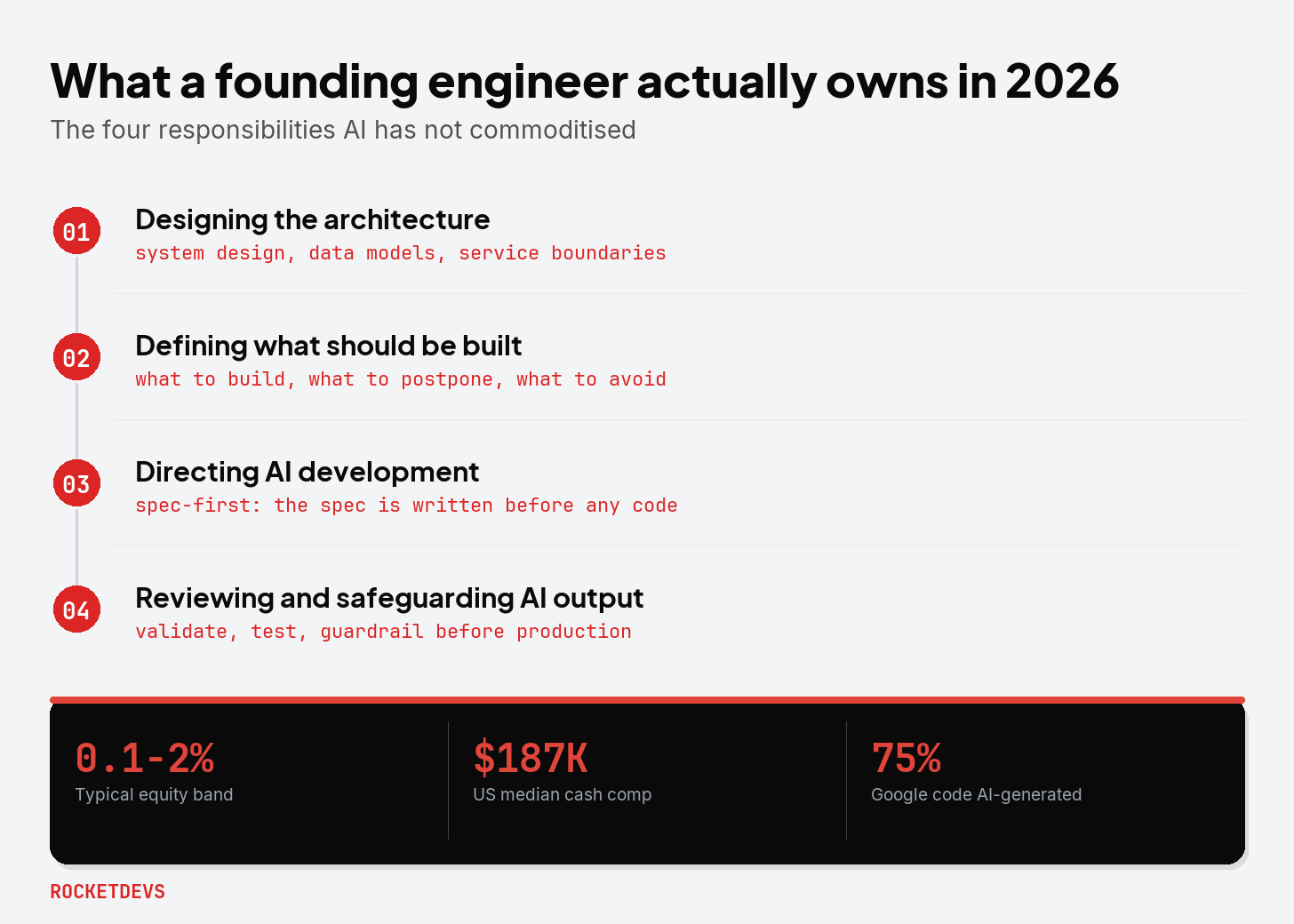
As a result, today's founding engineers focus on four core responsibilities that AI has not commoditised:
Designing the architecture. They make long-term technical decisions about system design, data models, infrastructure, and service boundaries—choices that become increasingly costly to change as the startup grows.
Defining what should be built. AI can generate code quickly, but it cannot reliably determine the right product priorities. Founding engineers decide what to build, what to postpone, and what to avoid altogether.
Directing AI development. Rather than writing every line of code themselves, founding engineers increasingly guide AI using detailed specifications and clear requirements. Spec-first workflows (the specification or "spec" is written before any code is generated or implemented) are becoming a common way to ensure AI builds the intended solution instead of simply generating code.
Reviewing and safeguarding AI output. AI-generated code still requires human verification. Founding engineers validate quality, test functionality, and use evaluation and guardrail tools to prevent errors, security issues, and unintended changes before code reaches production.
For founders, this changes what to look for when hiring. The strongest founding engineers are no longer just exceptional programmers—they are strong technical decision-makers who can design scalable systems, communicate clear requirements to AI tools, and ensure the software being produced is reliable, secure, and aligned with the company's goals.
How Much Equity and Salary does a founding engineer get?
Founding engineers are typically compensated with a combination of salary and equity. The exact mix depends on factors such as when they join the company, how much financial risk they are willing to take, and the startup's available funding. Earlier hires generally receive more equity because they take on greater uncertainty, while later hires tend to receive higher salaries and smaller ownership stakes.
What's normal for equity?
Founding-engineer equity usually ranges from 0.1% to 2% of the company. The first engineering hire is most likely to receive equity at the higher end of this range, while subsequent hires typically receive smaller allocations. Equity also tends to increase when a candidate accepts a below-market salary or leaves a secure, well-paid position to join an early-stage startup.
Most startups use a standard four-year vesting schedule with a one-year cliff, meaning equity is earned gradually over four years, with no shares vesting unless the employee remains with the company for at least one year.
Salary vs equity
Cash compensation varies by experience, location, and market conditions. According to compensation platform Pave, founding engineers in the United States earn around $187,000 at the median, with compensation reaching approximately $235,000 at the 90th percentile. Independent estimates from Paraform are broadly similar, with Y Combinator's benchmark placing typical salaries between $160,000 and $180,000, though estimates across the sources it compiles range considerably lower.
In most cases, salary and equity are a trade-off. Candidates who accept more equity often receive a lower salary, while those who prefer greater financial security usually receive less ownership. The right balance depends on the startup's funding, its hiring budget, and the level of risk both the founder and the candidate are prepared to accept.
For many seed-stage startups, hiring at US salary levels is simply not practical. As a result, many founders choose to hire experienced, vetted engineers from global talent markets, allowing them to access strong technical talent while staying within budget.
How Do You Vet a Founding Engineer When You Can't Read Code?
You don't need to be an engineer to hire a great founding engineer. The qualities that matter most—judgment, ownership, and decision-making—can all be evaluated without reviewing a single line of code. As AI takes on more of the coding work, the ability to make sound technical decisions has become a far better indicator of success than coding speed alone.
Judgment over speed
A strong founding engineer should be able to explain complex technical decisions in plain language. Ask candidates to describe a difficult technical decision they made, one they later reversed, or one they wish they had approached differently. Focus less on the technical details and more on how they evaluated trade-offs, managed risk, and thought about the long-term impact of their decisions.
The best candidates can clearly explain why they chose one approach over another, what compromises they made, and what they learned from the experience. If they cannot communicate these decisions to a non-technical founder, they may struggle to align the wider team as the company grows.
The spec-and-eval artifact test
One of the most effective ways to assess a founding engineer in 2026 is to review how they work before and after AI generates code. Ask candidates to show you how they document requirements, guide AI tools, and verify the results.
Look for evidence of a spec-first workflow, where the engineer creates a clear written specification before development begins. They should also be able to explain how they evaluate AI-generated code to ensure it meets the original requirements and maintains quality, security, and reliability. These documents are written in plain English, making them easy for non-technical founders to understand and assess.
References and a paid trial
References can help confirm whether a candidate took ownership of products and outcomes rather than simply completing assigned tasks. Speak to previous founders or managers about how the candidate handled responsibility, solved problems, and worked through uncertainty.
A short, paid trial provides even stronger evidence. Give the candidate a real but well-defined problem and observe how they approach it over one or two weeks. Pay attention to how they clarify requirements, plan the work, communicate progress, use AI tools where appropriate, and deliver a finished solution. A paid trial reduces hiring risk and gives you far more confidence than interviews alone when making one of your startup's most important early hires.
How RocketDevs Helps You Hire a Vetted Founding Engineer
The hiring framework outlined in this guide—evaluating judgment, reviewing spec-first workflows, checking references, and running a paid trial—is the same approach RocketDevs applies at scale. Rather than relying solely on resumes or coding tests, every developer completes 6–8 hours of human-led technical vetting designed to assess:
- technical ability;
- problem-solving;
- communication;
- and ownership.
More than 98% of applicants are rejected, meaning only the top 2% are presented to founders. Every developer holds a computer science degree and is a fluent English speaker, helping founders hire engineers who can communicate clearly as well as build great software. Today, more than 500 companies have used this process to hire engineering talent.
Hiring one of your first technical employees is a major decision, which is why reducing hiring risk is so important. RocketDevs includes a 14-day risk-free, money-back trial, allowing founders to evaluate an engineer on real work before making a long-term commitment. This gives you the opportunity to apply the same paid-trial approach recommended throughout this guide without taking unnecessary hiring risk.
RocketDevs offers vetted founding engineers starting at $9.99/hour for Associate developers, $21.99/hour for Mid-Senior developers, and $30.99/hour for Senior developers. If you'd like a step-by-step guide to the hiring process, RocketDevs also provides a comprehensive guide to hiring dedicated developers that walks through each stage in detail.
Conclusion
A founding engineer is one of the most important early hires a startup can make. They do far more than write code—they turn an idea into a working product, make critical technical decisions, and establish the foundation the company will build on.
As AI changes how software is created, the role is evolving. The best founding engineers are no longer defined only by how quickly they can code, but by their ability to make sound decisions, guide AI tools, manage complexity, and build the right things at the right time.
For founders, hiring a founding engineer is ultimately about finding someone who combines technical ability with ownership and judgment. By focusing on decision-making, communication, and a proven ability to execute, even non-technical founders can identify the right person to help turn their vision into reality.
FAQ
What is a founding engineer? A founding engineer is a startup's first, or one of its first, technical hires. They are responsible for turning an idea into a working product, building the company's technical foundation, and making many of the early engineering decisions that shape future growth. Founding engineers are typically employees who receive equity, rather than co-founders with ownership in the business.
What's the difference between a founding engineer and a CTO? A founding engineer focuses on building the first version of the product, while a CTO focuses on leading engineering teams and setting the company's long-term technical strategy. Most early-stage startups need a founding engineer first because their immediate challenge is launching a product, not managing a large engineering organization.
How much equity does a founding engineer receive? Founding engineers typically receive between 0.1% and 2% equity, depending on when they join the startup and how much financial risk they take. The first engineering hire usually receives the largest equity grant, and most startups use a four-year vesting schedule with a one-year cliff.
Should you hire a founding engineer or a CTO first? For most seed-stage startups, hiring a founding engineer first is the better choice. At this stage, success depends on building and shipping a product quickly. A CTO usually becomes necessary later, once the company begins scaling its engineering team and requires dedicated technical leadership.
How do you evaluate a founding engineer if you aren't technical? You don't need to read code to identify a strong founding engineer. Instead, focus on how candidates make decisions, communicate technical concepts, and take ownership. Ask them to explain a challenging technical decision, review how they document requirements before development, discuss how they verify AI-generated code, speak to previous employers or founders, and, where possible, use a short paid trial to see how they work in practice.
Author
James Hitch, COO at RocketDevs. Last updated: 2026-07-16.
Sources
- RocketDevs, "Can a co-founder also be your founding engineer?"
- RocketDevs, "How to find a technical co-founder"
- RocketDevs, "Founding Engineer vs CTO"
- RocketDevs, "How to build a tech team for a startup"
- John Kim, Paraform, "What is a founding engineer"
- Alberto Romero and Daniel Garcia, Generalist Engineer, "Why your startup needs a founding engineer"
- Underdog.io, "Founding Engineer: 2026 Guide to Role & Rewards"
- Matthew Schulman, Pave, "How much comp should the first engineer get"
- DevOps.com, "Google CEO says 75% of new code is AI-generated"
- Maxwell Zeff, TechCrunch, "Microsoft CEO says up to 30% of the company's code was written by AI"
- RocketDevs, "Hire Dedicated Developers"
- RocketDevs, "Pricing"

Written by
James Hitch
COO
James Hitch is the COO of RocketDevs, where he runs sales, recruiting, and the vetting operation that accepts only the top 2–3% of developer applicants. He cares about putting accessible, elite engineering talent within reach of founders and startups worldwide, at a fair price. He writes about technical hiring, building AI-native engineering teams, and how startups can access elite developers affordably.
More from our blog
Continue exploring insights and stories from RocketDevs