How Many Engineers do You Need to Raise a Seed Round? A 2026 Stage-By-Stage Playbook.
How many engineers you need to reach MVP and raise a seed round, what a lean vetted team costs by stage, and why capital efficiency gets you funded.


Table of contents
How many engineers do you need to raise a seed round in 2026? For most startups, the answer is fewer than you might think. A technical founder or first engineering hire is often enough to build a Minimum Viable Product (MVP), followed by a small team of three to four experienced engineers to gain the traction investors expect.
Today's seed investors are looking for more than a working product. They increasingly want evidence that customers are using and paying for it before they invest. At the same time, AI coding tools have made small engineering teams far more productive by automating much of the coding work. As a result, engineering judgment, product execution, and capital efficiency now matter far more than simply hiring more developers.
This guide explains how to size your engineering team at each stage of the startup journey, what investors expect before a seed round, and how to build enough technical capacity without overspending your runway.
Key takeaways
- Seed investors in 2026 increasingly expect startups to show real traction—typically around $5,000 to $50,000 in monthly recurring revenue (MRR)—rather than just a working MVP.
- A seed round should generally provide 18 to 24 months of runway (the length of time a startup can continue operating before it needs additional funding or becomes profitable) making team size one of the biggest factors affecting how long your funding will last.
- Most seed-stage startups operate with lean engineering teams, where a technical founder or engineering lead works alongside a small number of individual contributors.
- AI coding tools now generate a significant share of production code, allowing small, experienced engineering teams to achieve milestones that previously required much larger teams.
- Investors closely monitor burn multiple—the ratio of net burn to net new recurring revenue—as a key measure of capital efficiency, making engineering headcount one of the most important financial decisions at the seed stage.
In This Article
- The short answer: how many engineers to raise a seed round
- What each stage actually needs, from idea to scale
- How a lean vetted remote team is structured across stages
- What seed investors actually want to see in 2026
- What a startup engineering team actually costs
- The path from idea to a funded team, in order
- How RocketDevs fits, and the numbers behind it
- Conclusion
- FAQ
The Short Answer: How Many Engineers to Raise a Seed Round
Most startups do not need a large engineering team to raise a seed round. A Minimum Viable Product (MVP) - The first functional version of your product that includes only the core features needed to solve a real customer problem - can often be built by a technical founder or a single founding engineer. As the company grows, a small team of three to four experienced, high-judgment engineers is usually enough to reach the product and traction milestones investors expect at the seed stage. At this point, engineering quality and execution matter far more than team size.
This is a shift from the traditional approach of hiring aggressively before fundraising. In 2026, the funding landscape is more competitive. While AI startups continue to attract record investment, companies outside the AI sector often need stronger proof of product-market fit and efficient execution before securing seed funding. As a result, founders should focus less on building the largest possible team and more on building the smallest team capable of achieving meaningful milestones.
The key question is no longer, "How do I build an MVP?" Instead, founders should ask, "How many engineers do I need to reach the milestones that unlock a seed round without running out of runway?" The answer depends on your stage, product complexity, and growth goals, which the rest of this guide explores in detail.
In most cases, the most effective seed-stage strategy is to keep your engineering team lean. Every unnecessary hire increases payroll, shortens your runway, and raises the amount of capital you need before reaching your next milestone. A smaller, highly capable team gives founders more time to iterate, prove traction, and raise on stronger terms.
What Does Each Stage Actually Need, From Idea to Scale?
Each startup stage has a specific goal, and your engineering team only needs to be large enough to achieve it. Team size typically grows gradually, starting with a single technical founder or founding engineer at the idea stage, expanding to a small team during the seed stage, and only becoming a larger engineering organization once the business has demonstrated consistent, repeatable growth. If the title is new to you, here is what a founding engineer is.
The table below shows the typical engineering team size at each stage, the estimated monthly engineering cost, and the key milestones investors expect before funding the next round.
| Stage | What you're proving | Team size and roles | Rough monthly build cost | What the round expects |
|---|---|---|---|---|
| Idea / pre-seed | The idea is worth building | 1: a technical founder or first engineer, full-stack | One founder-engineer, or one vetted contractor from roughly $1,600 to $5,000 a month | A team and an early build. Per ValueAdd VC's 2026 breakdown of Carta data, a typical pre-seed is $750K to $1.5M on a $4-6M cap |
| MVP | People will actually use it | 1-2: founder-engineer plus a first hire | Roughly $3,500 to $10,000 a month for one to two vetted engineers | A working MVP and first real users, the "getting your MVP out the door" phase Bessemer describes |
| Seed | It's growing, not just working | A handful of ICs reporting to the founder or CTO | Roughly $12,000 to $18,000 a month for a 3-4 person vetted team | $5K to $50K MRR (Capwave), 18-24 months of runway (ValueAdd VC), a round of $2.5-3.5M on a $12-15M post-money (ValueAdd VC on Carta) |
| Scale / Series A | It's efficient and repeatable | Around 10 engineers under one technical leader before more structure helps (Bessemer) | Scales with headcount, and every seat is added burn | A burn multiple near 1.6x (Runway) on a round of roughly $10-15M (ValueAdd VC on Carta) |
The estimated monthly engineering costs for the vetted hiring route are based on RocketDevs' standard full-time hourly rates. They highlight an important advantage for early-stage startups: a team of three to four vetted engineers can cost roughly the same as hiring a single senior engineer in the US market. This allows founders to build faster while extending their runway.
Before deciding how many engineers to hire, make sure you have clearly defined what your MVP needs to achieve. A well-scoped MVP helps you avoid unnecessary hiring and ensures every engineer is focused on reaching the milestones required for your next funding round. If you're still refining your product scope, read RocketDevs' guides on MVP development for startups and common MVP building mistakes before planning your engineering team.
How is a Lean Vetted Remote Team Structured Across Stages
A lean engineering team is designed to maximize capital efficiency. One of the key metrics investors use to measure this is the burn multiple, which compares a company's net cash burn to the amount of new recurring revenue it generates. A lower burn multiple indicates that a startup is growing efficiently, making it a strong signal for investors evaluating seed-stage companies. In today's funding environment, capital efficiency often matters as much as growth itself.
For most startups, engineering salaries are the largest operating expense during the seed stage. That means headcount has the biggest impact on runway and burn multiple. Instead of hiring a large team of junior engineers, many successful startups build a smaller team of experienced engineers who can deliver more with fewer people. According to Runway's 2026 benchmarks, early-stage startups typically have burn multiples between 2.5x and 3.4x, while the median for Series A companies is around 1.6x. Burn multiples below 1.5x are generally considered strong. Every unnecessary hire increases costs and makes it harder to maintain these benchmarks.
Advances in AI coding tools have also changed how much a small engineering team can accomplish. AI now generates a significant share of production code at major technology companies. Google CEO Sundar Pichai has said that roughly 75% of Google's new code is AI-generated, while Microsoft CEO Satya Nadella reported that 20–30% of Microsoft's code is written by AI. Although these companies operate at a different scale, the trend is clear: experienced engineers who effectively use AI tools can deliver far more than similarly sized teams could just a few years ago. As a result, a team of three or four highly skilled engineers can often achieve what previously required six to ten developers.
This is why affordability and quality no longer need to compete. Hiring vetted engineers at competitive rates lowers payroll costs while reducing the risk of poor hiring decisions, costly rework, and employee turnover. The result is better engineering output without increasing burn. For most seed-stage startups, the technical founder or CTO continues to lead engineering directly, with every engineer contributing individually rather than through layers of management. As Bessemer Venture Partners notes, this structure typically remains effective until the engineering team reaches around 10 people, beyond which more structure starts to help. Keeping the team small allows founders to preserve runway, move quickly, and demonstrate the capital efficiency investors increasingly expect.
What do Seed Investors Actually Want to See in 2026
In 2026, seed investors are looking for more than a polished product. They want evidence that your startup can attract customers, generate revenue, and use capital efficiently. For most founders, that means proving traction before raising a seed round, rather than relying on a strong product demo alone.
Traction comes before features
Many institutional seed investors now expect startups to show meaningful traction before investing. This often means generating between $5,000 and $50,000 in monthly recurring revenue (MRR) or demonstrating other strong signs of product-market fit, such as rapid user growth, high customer engagement, or consistent retention. A product with no users may still be suitable for a pre-seed raise, but seed-stage investors increasingly expect proof that customers value what you've built.
As a result, your engineering team should be focused on reaching measurable business milestones rather than building as many features as possible. Every new hire should help move the company closer to customer adoption, revenue growth, and the metrics investors want to see.
Capital efficiency matters as much as growth
Investors also want to know that your startup can grow without spending unnecessarily. A typical seed round is expected to provide 18 to 24 months of runway, giving founders enough time to build the business before raising again. Some investors now prefer startups with 24 to 30 months of runway, particularly in a more cautious funding environment.
Because engineering salaries are usually the largest expense for an early-stage startup, every additional hire reduces runway. This is why decisions about team size are also decisions about fundraising. Keeping your engineering team lean helps preserve cash, improves capital efficiency, and gives your startup more time to reach the milestones needed for its next round.
What Does a Startup Engineering Team Actually Cost?
For most seed-stage startups, engineering salaries are one of the largest expenses. In the US, hiring a single founding engineer can consume a significant portion of your monthly budget. Building a vetted global team, however, can deliver similar development capacity at a much lower cost, giving founders more time to reach key milestones before raising their next round.
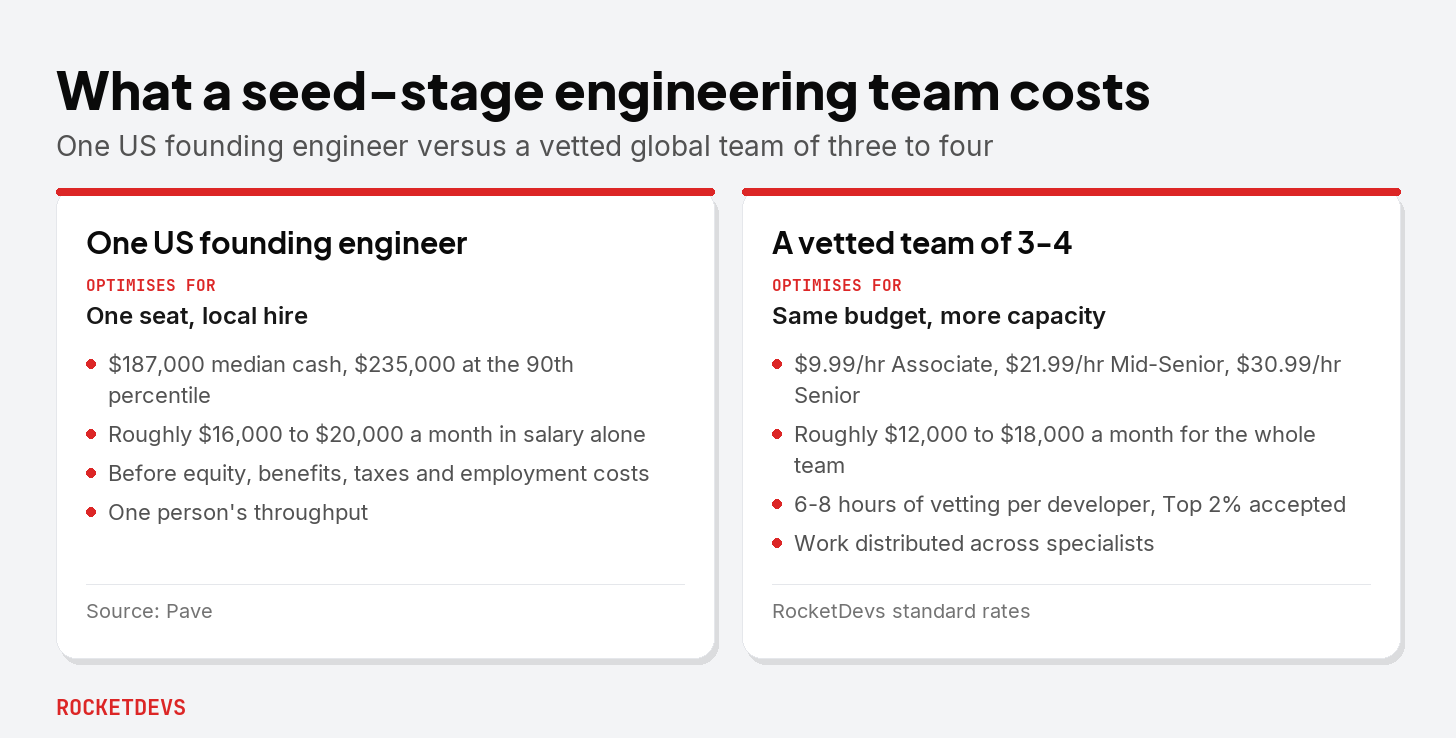
According to compensation platform Pave, the median cash salary for a first or founding engineer in the US is approximately $187,000 per year, rising to around $235,000 at the 90th percentile. That works out to roughly $16,000–$20,000 per month in salary alone, before accounting for equity, benefits, taxes, and other employment costs. For an early-stage startup, a single hire at this level can represent a substantial share of the company's monthly burn.
A vetted global team changes that equation. Using RocketDevs' standard rates—$9.99/hour for Associate engineers, $21.99/hour for Mid-Senior engineers, and $30.99/hour for Senior engineers—a founder can typically build a team of three to four full-time engineers for approximately $12,000–$18,000 per month. Instead of dedicating most of the engineering budget to one developer, founders can distribute work across specialists while keeping costs under control.
The savings directly extend your runway. Every dollar not spent on an oversized payroll is another dollar available to build the product, acquire customers, and hit the traction milestones investors expect before a seed round. For guidance on how your engineering organization should evolve as you grow, read our guide on how to build a tech team for a startup.
The Path from Idea to a Funded Team, In Order
Raising a successful seed round is not about hiring as many engineers as possible. It is about making the right hiring decisions at the right time. Each stage should support a clear business milestone, helping you build momentum while keeping your burn rate under control.
- Define your MVP before building your team. Start by clearly outlining your minimum viable product (MVP) and identifying the single metric that will demonstrate traction. Every future engineering hire should help you achieve a specific milestone, rather than simply increasing headcount.
- Hire your first engineer for experience and judgment. Your first technical hire will shape the product architecture, engineering standards, and development process. As AI tools increasingly handle routine coding tasks, this engineer's ability to make sound technical decisions becomes even more valuable. Learn more about what to look for in our guide to Founding Engineer vs. CTO.
- Build and launch your MVP with a small team. In most cases, one or two experienced engineers are enough to build the first version of your product. Focus on shipping the smallest product that solves a real problem and getting it into the hands of real users as quickly as possible.
- Keep your seed-stage team lean. Once you begin gaining traction, expand to a small team of three or four experienced engineers. At this stage, every engineer should be an individual contributor. Avoid adding management layers until the business has demonstrated consistent growth.
- Track your burn rate and runway from the beginning. Monitor your spending alongside your progress. Investors want to see that you are using capital efficiently, so keeping a close eye on metrics such as burn rate, runway, and burn multiple will help you make better hiring decisions.
- Achieve meaningful traction before raising your seed round. Investors increasingly expect startups to demonstrate measurable progress before investing. For many SaaS startups, this means reaching approximately $5,000 to $50,000 in monthly recurring revenue (MRR) or showing similarly strong traction signals.
- Raise enough capital to fund your next stage of growth. Aim to raise enough funding to support 18 to 24 months of operations. Increase your engineering headcount only after your product, customer acquisition, and revenue growth have become repeatable. Scaling too early can shorten your runway without improving your chances of success.
How RocketDevs Helps You Build the Lean Vetted Team That Gets You Funded
The key to reaching a successful seed round is not building the biggest engineering team—it's building the right one. A lean, highly skilled team allows you to move quickly, control costs, and demonstrate the capital efficiency that investors expect. RocketDevs is designed to help founders do exactly that.
Every developer in the RocketDevs network completes 6–8 hours of human-led technical vetting, assessing not only technical ability but also problem-solving, communication, and ownership. More than 98% of applicants are rejected, leaving only the top 2% available to founders. The result is a carefully vetted talent pool that has helped more than 500 companies build engineering teams, with 98% of placements reaching project completion.
Hiring early is one of the biggest decisions a founder makes, and a poor hire can quickly drain valuable runway. To reduce that risk, RocketDevs offers a 14-day risk-free trial with every placement, backed by a money-back guarantee. This allows founders to evaluate engineers in a real working environment rather than relying solely on interviews. As your company grows beyond the seed stage, our guide on scaling a startup explains how your engineering team should evolve.
If you're building toward a seed round, RocketDevs provides access to the top 2% of vetted developers at transparent rates: $9.99/hour for Associate engineers, $21.99/hour for Mid-Senior engineers, and $30.99/hour for Senior engineers. Combined with rigorous vetting and a 14-day risk-free trial, founders can build an experienced engineering team while preserving the runway needed to reach the next funding milestone.
Conclusion
There is no magic number of engineers required to raise a seed round. What investors care about is whether your team can build efficiently, reach meaningful traction, and use capital wisely. For most startups, that means starting with one experienced founding engineer, growing to three or four strong individual contributors by the time you raise, and expanding further only after you've proven product-market fit.
A lean engineering team gives you more than lower costs—it gives you a longer runway, faster iteration, and a stronger story for investors. Every hiring decision should move your startup closer to its next milestone, whether that's launching an MVP, acquiring customers, or reaching recurring revenue targets.
By focusing on experienced, carefully vetted engineers instead of simply increasing headcount, founders can build high-quality products while preserving the capital needed to grow. When it's time to raise, investors will see a startup that has demonstrated traction, discipline, and the ability to execute—all qualities that matter far more than the size of your engineering team.
If you're ready to build an engineering team that helps you reach your next funding milestone, RocketDevs connects founders with the top 2% of vetted developers at startup-friendly rates, allowing you to scale efficiently without sacrificing quality or runway.
FAQ
How many engineers do you need to raise a seed round? There is no fixed number, but most startups do not need a large engineering team to raise a seed round. Many companies build their MVP with a technical founder or a single experienced founding engineer before expanding to a lean team of three or four experienced engineers. At this stage, investors are far more interested in traction, product progress, and capital efficiency than in the size of your engineering team.
How much does a startup engineering team cost? The cost depends on where you hire. According to Pave, a first or founding engineer in the US typically earns $187,000–$235,000 per year in cash compensation, or roughly $16,000–$20,000 per month before equity and benefits. By comparison, a vetted global team of three to four RocketDevs engineers can typically be built for $12,000–$18,000 per month, allowing founders to increase development capacity while preserving runway.
How much runway should a seed round provide? Most founders should aim for 18 to 24 months of runway after raising a seed round. Some investors now encourage startups to plan for 24 to 30 months, particularly in a more selective funding environment. Since engineering salaries are usually the largest operating expense, keeping your team lean is one of the most effective ways to extend your runway.
Do you need a technical co-founder to raise a seed round? Not necessarily. What matters is having someone capable of building the product and establishing a strong technical foundation. That could be a technical co-founder or an experienced founding engineer. Ultimately, investors evaluate your ability to execute, demonstrate traction, and use capital efficiently—not the job title of your first technical leader.
Can a remote engineering team help you reach MVP faster? Yes. A small team of experienced, vetted remote engineers can often build an MVP more quickly and at a lower cost than a traditional local team. As AI coding tools continue to improve developer productivity, the biggest differentiator is no longer location—it's the quality and experience of the engineers guiding the work.
Author
James Hitch, COO at RocketDevs. Last updated: 2026-07-16.
Sources
- Carta, "State of Private Markets: Q4 2025"
- PitchBook, "Q1 2026 PitchBook-NVCA Venture Monitor"
- David Sacks, Craft Ventures, "The Burn Multiple"
- Wall Street Prep, "Burn Multiple"
- Runway, "Burn Multiple Benchmarks for 2026"
- DevOps.com, "Google CEO says 75% of new code is AI-generated"
- TechCrunch, "Microsoft CEO says up to 30% of the company's code was written by AI"
- Bessemer Venture Partners, "Scaling your engineering team from one to 50 and beyond"
- Bessemer Venture Partners, "Roadmap: 10 laws of cloud"
- Capwave, "Pre-Seed vs Seed Funding: what's different in 2026"
- CRV, "MVP Stage of Startup: what investors expect before Series A"
- ValueAdd VC, "Startup Funding 2026: what's normal at pre-seed, seed, A and B"
- Puzzle, "The Complete Founders' Guide to Burn Rate and Runway"
- Matthew Schulman, Pave, "How much comp should the first engineer get"
- RocketDevs, "How to build a tech team for a startup"
- RocketDevs, "Founding Engineer vs. CTO"
- RocketDevs, "Scaling a Startup"
- RocketDevs, "Get Started"
- RocketDevs, "Pricing"

Written by
James Hitch
COO
James Hitch is the COO of RocketDevs, where he runs sales, recruiting, and the vetting operation that accepts only the top 2–3% of developer applicants. He cares about putting accessible, elite engineering talent within reach of founders and startups worldwide, at a fair price. He writes about technical hiring, building AI-native engineering teams, and how startups can access elite developers affordably.
More from our blog
Continue exploring insights and stories from RocketDevs