How to Evaluate a Developer When You Can't Read the Code
You don't need to read code to hire well. A practical, non-technical framework for evaluating developers, plus the red flags anyone can spot.


Table of contents
Hiring a developer can feel overwhelming if you don't have a technical background. Many business owners worry that they need to understand programming languages or review lines of code to know whether a candidate is any good. In reality, that's not what separates successful hiring decisions from poor ones.
The key is to focus on evidence rather than technical expertise. Instead of asking yourself whether you can judge the quality of someone's code, ask whether you can verify the results they've delivered. A developer should be able:
- to explain a real project in clear, simple language;
- provide references from previous clients or employers;
- complete a paid trial task;
- and demonstrate a structured approach to solving problems.
This evidence-based approach gives non-technical founders and hiring managers the confidence to make informed decisions without needing to become developers themselves. Whether you're hiring a freelance contractor or building an entire engineering team, evaluating proven skills, communication, and reliability will lead to better hiring outcomes than trying to assess code you can't read.
You're not grading the code; you're grading whether the explanation holds together.
In this article
- Why is evaluating developers so hard for non-technical founders?
- What can you actually assess without reading code?
- What does a real vetting process check, and why can't you fake it with one test?
- What red flags should a non-technical founder watch for?
- When should you bring in outside technical help, and when is that overkill?
- How RocketDevs does this evaluation for you
- FAQ
Why is evaluating developers so hard for non-technical founders?
One of the biggest challenges non-technical founders face when hiring developers is that they cannot easily evaluate the quality of the code itself. As a result, many rely on other signals such as confident interview answers, an impressive portfolio, or personal recommendations. While these can be helpful, they do not provide reliable proof of a developer's ability to deliver high-quality work. This often leads founders to judge communication skills and confidence instead of technical competence and real-world results.
This is not a problem that can be solved by watching a few coding tutorials or reading introductory programming guides. Even experienced engineering leaders avoid assessing technical areas outside their own expertise. As KORE1 explains in its guide for hiring managers, someone without experience in a specialised field should not try to judge the technical depth of a candidate's answers. The same principle applies to non-technical founders who are hiring developers. Rather than trying to become technical experts overnight, founders should focus on evaluating outcomes, problem-solving ability, and proven experience through practical assessments and verified work samples.
What can you actually assess without reading code?
One of the hardest parts of hiring developers as a non-technical founder is that you cannot judge the code directly. That leaves you with indirect signals like polished interview answers, a strong portfolio, or a trusted referral. Those can help, but they do not prove that someone can deliver solid work. Too often, founders end up rewarding confidence and communication instead of real technical skill and results.
You do not solve that problem by skimming a few coding tutorials or reading beginner guides. Even experienced engineering leaders avoid judging areas outside their expertise. As KORE1 notes in its hiring guide, people without experience in a specialized field should not try to assess the technical depth of a candidate's answers.
For non-technical founders, the better approach is to focus on outcomes, problem-solving, and evidence of past work. Practical tests and verified examples tell you far more than a polished interview ever will.
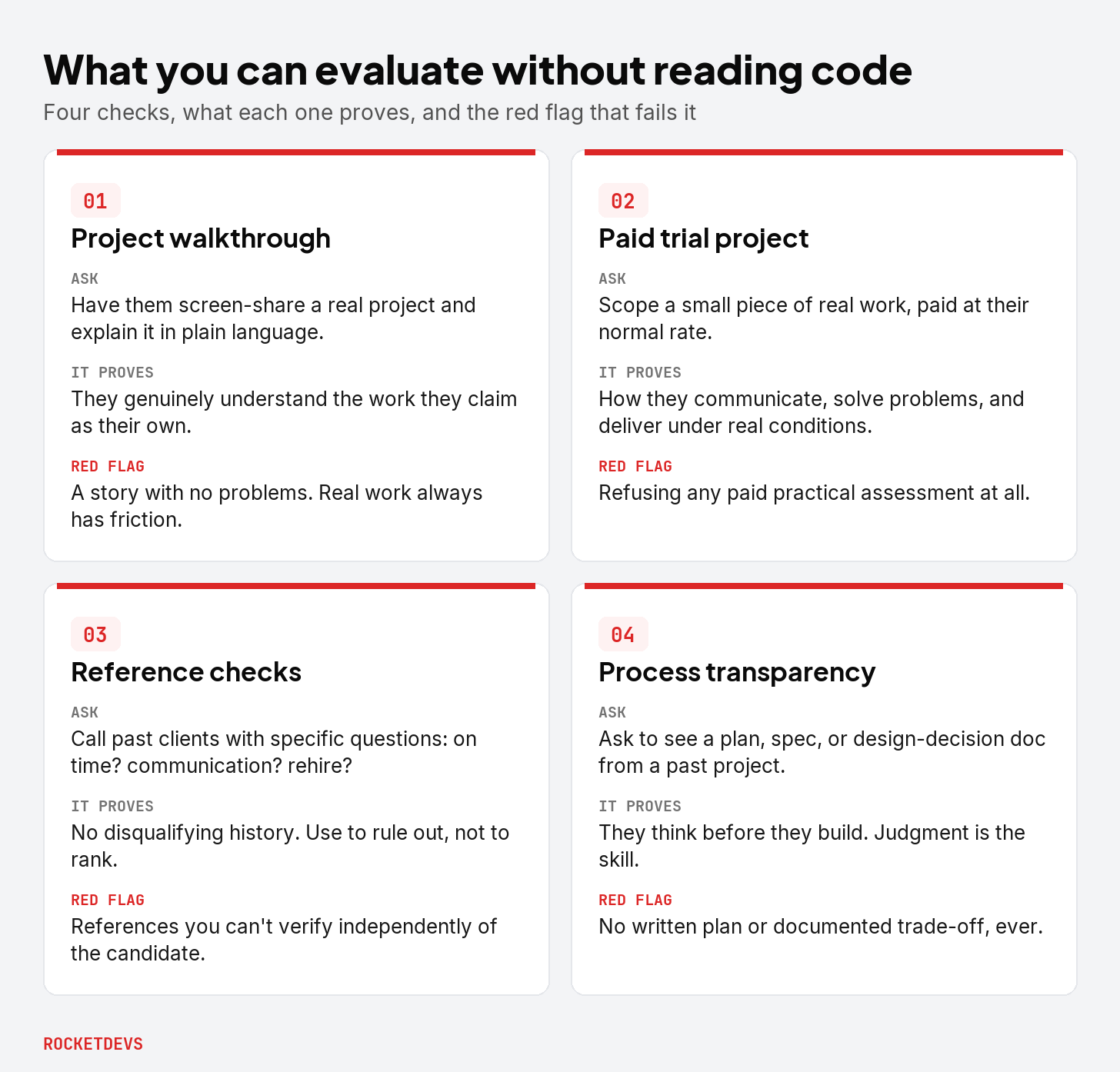
The non-technical evaluation checklist:
- The project walkthrough. Ask the candidate to screen-share a real project and explain what it does, why they built it that way, and what they'd change today. You're not grading the code; you're grading whether the explanation holds together.
- A paid trial project. A small, separately scoped piece of real work, paid at their normal rate that is run before you commit to anything larger.
- References, checked for disqualifiers. Not to find your best candidate, but to catch anyone who has burned previous clients or teams.
- Process transparency. Do they plan and document before building, and will they show you that artifact.
A paid trial project is one of the most reliable ways to evaluate a developer when you can't read their code. Experienced freelance developer Michael Lynch openly states that every trial should be paid, even if no long-term contract follows. This approach allows both sides to assess whether the working relationship is a good fit. Hiring platform FreeUp reaches the same conclusion, noting that interviews often fail to predict real performance. Some candidates interview confidently but struggle with the work, while others may not interview well yet consistently deliver excellent results. A short, paid project shows what a developer can actually accomplish.
References are also useful, but they should not carry too much weight. Research published in the Journal of Applied Psychology found that structured interviews are much better predictors of job performance than reference checks. References are most valuable for identifying potential red flags rather than choosing the best candidate. In other words, use them to confirm that a developer is trustworthy and reliable, but base your hiring decision on stronger evidence such as real work samples, a paid trial project and a clear development process.
What does a real vetting process check, and why can't you fake it with one test?
No single hiring test can tell you everything you need to know about a developer. Coding tests, take-home assignments and interviews all measure different skills, but each has its limitations. A take-home task may not reflect how someone performs on a real project and, with the rise of AI coding tools, it is becoming easier for candidates to generate or heavily assist their submissions. Interviews can favour people who communicate confidently rather than those who consistently produce high-quality work. Even portfolios should be viewed with caution, as it is often difficult to determine exactly what role a developer played in a team project.
For this reason, the strongest hiring process combines several forms of assessment instead of relying on just one. A practical skills assessment, a discussion about previous work, a paid trial project and reference checks each provide a different piece of the puzzle. Looking at multiple sources of evidence makes it much harder for a candidate to misrepresent their abilities and gives you a far more accurate picture of how they are likely to perform once they join your team.
Another valuable signal has emerged alongside the rapid adoption of AI-assisted software development: how a developer plans their work before they begin writing code. Modern development is no longer just about producing code quickly. Skilled developers spend time understanding the problem, defining the requirements and thinking through different solutions before they start building. Open-source AI development tools such as spec-superflow (239 stars) and umadev (223 stars) both emphasise this approach, separating the planning stage from implementation and requiring work to be tested and verified rather than simply accepted because an AI tool says it is correct.
As a non-technical founder, you can use this to your advantage. Ask candidates to explain how they approach a new project and request examples of their planning documents, technical specifications or design decisions. A developer who can clearly explain why they chose a particular solution, what trade-offs they considered and how they validated their work is demonstrating sound engineering judgment. That ability to think critically and communicate their process is often a much stronger indicator of future success than the code itself.
What red flags should a non-technical founder watch for?
As a non-technical founder, you do not need to identify coding mistakes to spot a poor hire. Instead, pay attention to behaviours that are easy to observe and verify. Strong developers are usually transparent about their work, willing to explain their decisions and comfortable providing evidence of their experience. Candidates who avoid straightforward questions or resist reasonable parts of the hiring process should be approached with caution. The following red flags can help you identify potential problems before making a hiring decision.
Vague Answers to "Walk Me Through This Project"
One of the simplest and most effective questions you can ask is, "Can you walk me through a project you built?" A capable developer should be able to explain the project's purpose, the challenges they encountered, the decisions they made and the outcome in language you can understand. You are not testing their technical vocabulary, you are assessing whether they genuinely understand the work they claim to have done.
Be cautious if the candidate gives overly vague answers, avoids specific details or relies heavily on technical jargon without explaining it. Likewise, if they struggle to describe their own role in a team project or cannot explain why certain decisions were made, it may indicate that their contribution was limited or that they lack a deep understanding of the work. Clear, honest explanations are a strong sign of competence and professionalism.
Beware of candidates who cannot name a single real problem they faced while building. It is highly unlikely for a developer not to face any challenges or problems whilst creating a project. In fact, this should actually raise a red flag to an employer as in reality real work has friction. The absence of any problems at all typically translates to the candidate not actually working on the project in question, or they do not fully understand the project enough to delve into its weak points.
No Verifiable References
References can provide valuable reassurance, but only if they are genuine and independently verifiable. Anyone can provide the names of people who will speak positively about them. What matters is whether those references can confirm a real working relationship and provide meaningful insight into the candidate's performance. Ideally, references should come from previous clients, managers or colleagues who can discuss specific projects, deadlines and the developer's role in delivering the work.
When speaking to a reference, ask practical questions rather than general ones. Did the developer deliver work on time? How did they communicate when problems arose? Would you hire them again? Specific answers are far more valuable than vague praise. If a reference struggles to remember the project, cannot describe the developer's contribution or gives only generic compliments, treat the recommendation with caution.
You should also be able to verify the reference independently. The company should exist, the project should be real and the contact details should not rely solely on information provided by the candidate. A trustworthy reference provides evidence that supports the developer's claims, rather than simply reinforcing them.
Refusal to Complete a Paid Trial Project
A paid trial project is one of the fairest and most effective ways to evaluate a developer before making a long-term commitment. It gives you the opportunity to see how the candidate communicates, solves problems, responds to feedback and delivers work under normal conditions. At the same time, the developer is fairly compensated for their time and expertise. Both parties benefit from the arrangement.
Professional developers are generally comfortable completing a small, well-defined paid trial because it allows them to demonstrate their skills through real work instead of relying solely on interviews or résumés. In fact, asking candidates to complete unpaid work is widely discouraged within the software industry. If you want to assess a developer's abilities, you should always be prepared to pay them for their time.
While there may be legitimate reasons why a candidate cannot complete a trial immediately, such as existing contractual obligations or limited availability, an outright refusal to participate in any paid practical assessment should prompt further questions. If someone expects to be hired based only on their claims, with no willingness to demonstrate how they work, you are taking on unnecessary risk. Whenever possible, make hiring decisions based on evidence you can observe and verify, rather than promises alone.
When should you bring in outside technical help, and when is that overkill?
Non-technical founders do not need a technical expert involved in every stage of the hiring process. In fact, many of the most important parts of evaluating a developer can be done without writing or reading a single line of code. You can assess how clearly a candidate communicates, whether they can explain previous projects, how they approach problem-solving, whether they complete a paid trial professionally and what past clients or employers say about working with them. These are all valuable indicators of future performance, and they do not require technical expertise.
However, there comes a point where technical knowledge does matter. If you need to judge the quality of a developer's architecture decisions, the efficiency of their code or whether they are following software engineering best practices, it is time to involve someone with the right expertise. Trying to evaluate technical depth without the necessary experience can lead to poor hiring decisions, either by rejecting a capable developer or hiring someone whose technical skills are weaker than they appear.
Bringing in outside technical help does not have to mean hiring a full-time engineering manager. Many founders ask an experienced developer, a trusted technical advisor or a specialist recruitment partner to review candidates at the appropriate stage of the process. This technical reviewer can examine the code produced during a paid trial project, ask more advanced technical questions and identify issues that would be difficult for a non-technical founder to spot.
The key is to use technical expertise where it adds the most value, rather than throughout the entire hiring process. Let the technical reviewer assess the quality of the code, while you focus on the factors you are best placed to evaluate: communication, professionalism, reliability, problem-solving and cultural fit. By dividing responsibilities this way, you make better hiring decisions without adding unnecessary complexity or expense to the recruitment process.
How RocketDevs does this evaluation for you
Everything discussed in this guide, reviewing previous projects, assessing technical ability, checking references, evaluating communication and verifying a developer's process, is designed to reduce hiring risk. The challenge for many founders is that carrying out this level of due diligence takes time and, in some cases, technical expertise. RocketDevs was built to solve that problem by completing much of the evaluation before a developer is ever introduced to a client.
According to RocketDevs, every developer goes through a structured five-stage vetting process that includes experience verification, technical assessments, AI-assisted skill analysis, live technical interviews and soft skills screening. Each assessment takes between six and eight hours to complete, and fewer than 2% of applicants are accepted onto the platform. The company also provides transparency into the process by making assessment results and interview information available to clients, allowing founders to see how each developer performed rather than relying solely on a résumé.
For non-technical founders, this means much of the technical evaluation has already been carried out by people who have the expertise to assess coding ability, software design and engineering best practices. Instead of trying to determine whether a candidate's code is technically sound, founders can focus on the areas they are best placed to evaluate, such as communication, problem-solving, cultural fit and whether the developer understands the business goals of the project.
That does not mean you should skip your own hiring process. Even with pre-vetted developers, it is still good practice to discuss previous projects, ask candidates to explain their approach to solving problems and, where appropriate, begin with a small paid trial project. RocketDevs aims to remove much of the uncertainty from technical hiring, but the final decision should always be based on both technical evidence and your confidence that the developer is the right fit for your team and your business. See the full hiring process guide if you are ready to skip the guesswork. Elite Talent. Honest Price.
FAQ
How can I evaluate a developer if I don't know how to code?
Focus on what you can verify without reading code: a walkthrough of a real project including the problems they hit, a small paid trial task, checkable references, and whether they document a plan before building. These signals predict judgment and reliability better than code style you couldn't assess anyway.
What questions can a non-technical founder ask to assess a developer?
Ask them to walk you through a project they built, including something that went wrong and how they handled it. Ask what they'd change if they rebuilt it today. Ask to see any written plan or set of trade-offs from a past project. None of these require technical knowledge, only whether the answer is specific and checkable.
Are reference checks more reliable than technical interviews?
No, and this is a common misconception. The most current meta-analytic research on hiring-method validity, Sackett, Zhang, Berry and Lievens (2022), found structured interviews are a stronger predictor of job performance than reference checks. Use references to catch disqualifying problems, not to pick your top candidate.
What are red flags when hiring a developer as a non-technical founder?
Vague or evasive answers about past projects, references you can't actually verify, and refusal to do any form of paid trial work are the three clearest signals, and none require technical knowledge to spot.
Should I hire a technical advisor to help me evaluate developers?
Only for the parts of the decision that require judging technical depth, like architecture trade-offs or code quality. For everything else, the project walkthrough, the trial, references, and process transparency, you can run yourself.
Sources
- Sackett, Zhang, Berry & Lievens (2022), Journal of Applied Psychology
- ClarityHire, The Predictive Validity of Hiring Methods
- Michael Lynch, Guidelines for Freelance Developers Working with Me
- FreeUp, How To Use A Test Project To Vet Freelancers
- Hatchways, How to Walk Through a Project in an Interview
- KORE1, Technical Interview Guide for Hiring Managers
- spec-superflow (GitHub)
- umadev (GitHub)
James Hitch, COO at RocketDevs Last updated: 2026-07-08

Written by
James Hitch
COO
James Hitch is the COO of RocketDevs, where he runs sales, recruiting, and the vetting operation that accepts only the top 2–3% of developer applicants. He cares about putting accessible, elite engineering talent within reach of founders and startups worldwide, at a fair price. He writes about technical hiring, building AI-native engineering teams, and how startups can access elite developers affordably.
More from our blog
Continue exploring insights and stories from RocketDevs