AI Fluency: The New Professional Baseline Every Developer and Tech Team Needs in 2026
Discover why AI fluency is the essential skill for developers and tech teams in 2026, and how mastering AI tools is becoming the new baseline for professional success.


Table of contents
There was a time, not long ago, when the phrase “AI fluency” would have drawn blank stares in most professional settings. It sounded academic, niche, and firmly planted in the territory of data scientists and machine learning researchers. That time is over. In 2026, AI fluency has emerged as the single most important professional competency across industries, and for developers and technical teams in particular, it has become the dividing line between relevance and obsolescence.
| Metric | Insight | Source |
|---|---|---|
| 56% | Wage premium for workers with advanced AI skills | PwC, 2025 |
| 7x | Growth in roles requiring AI fluency from 2023 to 2025 | McKinsey |
| 120M | Workers at medium-term risk of redundancy without reskilling | WEF |
This is not a trend that can be observed from a distance. The World Economic Forum has reported that the vast majority of employers now plan to prioritise workforce upskilling by the end of the decade, with an estimated 120 million workers at medium-term risk of redundancy if they do not receive the training they need. PwC’s research paints an even sharper picture: workers who possess advanced AI skills are earning wage premiums of up to 56% compared with peers in the same roles who lack those capabilities. AI fluency is no longer a nice-to-have credential. It is a financial and career imperative.
For companies building remote development teams, and for the developers who comprise them, this shift carries enormous implications. The question is no longer whether your team uses AI tools. It is whether they understand those tools deeply enough to wield them with precision, judgment, and strategic intent.
What AI Fluency Actually Means (And What It Does Not)
It is worth pausing to define the term clearly, because “AI fluency” is not the same thing as “knowing how to use ChatGPT.” The distinction matters. AI literacy, at its most basic level, means understanding what artificial intelligence is and having a general sense of what it can do. AI fluency goes considerably further. It refers to the ability to evaluate, apply, and integrate AI tools and capabilities within specific professional workflows, to understand their limitations and failure modes, to make sound judgments about when and how to deploy them, and to adapt as the technology evolves.
Salesforce AI Fluency Framework__: Engagement (sentiment and willingness to experiment) + Activation (consistent, habitual use in daily workflows) + Expertise (ability to orchestrate AI-augmented work across the enterprise). The message is clear: using an AI tool once a week is not fluency. Building the habit, understanding the reasoning patterns, and knowing how to course-correct is.
Salesforce recently released its AI Fluency Playbook, a framework the company developed internally and now shares with enterprise customers. The playbook organises fluency around three measurable dimensions: engagement, which tracks employee sentiment and willingness to experiment with AI; activation, which measures consistent and habitual use of AI tools in daily workflows; and expertise, which addresses the ability to bring together human, business, and technical skills to orchestrate AI-augmented work across an organisation.
This framework is useful because it moves the conversation beyond surface-level adoption metrics. It is not enough for a developer to use an AI coding assistant once a week. Fluency means building the habit, understanding the tool’s reasoning patterns, recognising when it produces unreliable output, and knowing how to course-correct. Part of that discipline is using AI coding agents without drowning in output.
For software developers specifically, AI fluency encompasses several layers. At the foundational level, it includes understanding how large language models work, what they are trained on, and why their outputs can be both impressively coherent and subtly wrong. At the applied level, it means being able to use AI coding tools like GitHub Copilot, Claude Code, or similar assistants effectively within real development workflows, including writing prompts that produce useful code, reviewing AI-generated output with the same rigour one would apply to a junior developer’s pull request, and understanding the security and licensing implications of code that may have been influenced by training data.
At the strategic level, AI fluency for developers means being able to evaluate new tools and capabilities as they emerge, to make informed recommendations to team leads and stakeholders about when AI augmentation makes sense and when it introduces risk, and to continuously adapt one’s own workflow as AI capabilities expand.
Top Read: Can A Cofounder Also Be A Founding Engineer?
AI Literacy vs AI Fluency
| Skill Level | Description | Usage | Awareness | Learning Approach |
|---|---|---|---|---|
| AI Literacy | Understanding what AI is and what it can generally do | Occasional, experimental usage | Passive awareness of AI capabilities | One-time learning |
| AI Fluency | Evaluating, applying, and integrating AI tools within specific professional workflows | Consistent, habitual integration into daily work with measurable outcomes | Active judgment about when, how, and whether to deploy AI in a given context | Continuous adaptation as models, tools, and best practices evolve |
| Tool Familiarity | Surface-level familiarity with popular tools | Occasional usage | Basic awareness | Introductory learning |
| Tool Mastery | Deep understanding of tool limitations, failure modes, and when to override AI output | Integrated into workflow with oversight | Expert judgment | Continuous practice and evaluation |
Why AI Fluency Has Become Non-Negotiable in 2026
The acceleration has been remarkable. According to McKinsey’s workforce research, the number of workers in occupations where AI fluency is explicitly required grew sevenfold in just two years, from approximately one million in 2023 to around seven million by 2025. That is the fastest-growing skill category in job postings across the United States, and the trajectory has only steepened since. AI-related job postings peaked at 16,000 per month in late 2024, and positions requiring generative AI skills quadrupled over that same two-year window.
The demand is not confined to traditional tech roles. Three-quarters of current AI skill demand is concentrated in computer and mathematical occupations, management, and business and financial operations, but healthcare, consulting, education, and staffing industries are catching up rapidly. Gartner estimates that over 80% of enterprises will have deployed generative AI-enabled applications by 2026. The firms predict that 80% of the engineering workforce will need to upskill through 2027 just to keep pace with the technology’s evolution.
For companies that hire remote developers, whether through platforms like RocketDevs or through direct recruitment, this represents a fundamental shift in what “qualified” means. A developer with strong technical fundamentals in, say, React or Python is no longer automatically well-equipped for the modern development environment. That same developer also needs to demonstrate fluency with AI-assisted development tools, an understanding of how to integrate AI capabilities into applications they build, and the judgment to evaluate and manage AI-generated outputs.
The economic incentives are unmistakable:PwC’s 2025 Global AI Jobs Barometerfound that industries most exposed to AI are experiencing nearly 4x higher productivity growth than those with less AI exposure. The companies mastering AI integration are not just keeping pace. They are pulling away from competitors at an unprecedented rate.
Since generative AI’s widespread adoption began in 2022, productivity growth in AI-exposed industries jumped from 7% to 27%.
The Five Pillars of AI Fluency for Development Teams
Based on industry research, enterprise frameworks, and the real-world needs of companies building software with distributed teams, AI fluency for developers rests on five interconnected pillars.
Foundational AI Understanding: This is the baseline: understanding what AI models are, how they generate outputs, what their training data limitations look like, and why hallucination and bias are persistent challenges. Without this foundation, developers cannot make informed decisions about anything that follows. A developer who does not understand why an AI coding assistant might generate code that looks correct but introduces a subtle security vulnerability is a developer who will, sooner or later, introduce that vulnerability into production.
Applied Tool Proficiency: This pillar addresses the hands-on skills: using AI coding assistants effectively, writing prompts that generate useful outputs, understanding how to provide context that improves AI-generated code quality, and knowing how to integrate AI tools into existing development workflows, CI/CD pipelines, and testing processes. Applied proficiency also means knowing the limitations of specific tools. Stack Overflow’s 2025 Developer Survey](https://stackoverflow.co/company/press/archive/stack-overflow-2025-developer-survey/#:~:text=Gen%20Z%20developers%20(ages%2018,developers%20in%20Ukraine%20at%2041%25.))">https://stackoverflow.co/company/press/archive/stack-overflow-2025-developer-survey/#:~:text=Gen Z developers (ages 18,developers in Ukraine at 41%.) showed that while 84% of developers are now using AI tools, a significant proportion do not trust the accuracy of AI outputs, and nearly two-thirds reported ethical and security concerns about AI-generated code.
Critical Evaluation and Review: This is perhaps the most important pillar for software developers. AI-generated code must be reviewed with the same level of scrutiny, if not more, that one would apply to code written by a human. This means checking for correctness, security, performance, maintainability, and adherence to project standards. Research from Fastly has found that developers frequently need to manually fix AI-generated code. Critical evaluation also extends to understanding licensing implications, particularly given that AI coding tools were trained on publicly available code, including code under restrictive licences.
Strategic Decision-Making: Fluent developers are not just consumers of AI tools. They are advisors to their teams and organisations about how, when, and where AI should be deployed. This includes evaluating new tools as they emerge, recommending integration strategies, assessing risk and compliance requirements, and contributing to governance frameworks that ensure AI is used responsibly.
Continuous Learning and Adaptation: The AI landscape is evolving at a pace that renders any static body of knowledge quickly outdated. Fluency, therefore, is not a destination but a practice. Developers who are truly AI-fluent treat learning as a continuous process, staying current with new model releases, tool updates, and emerging best practices. Fast Company’s analysis of organisational AI readiness frames this well: the organisations winning with AI are not those with the most tools but those with the most systematic approach to capability development.
Best Read: 13 Best App Building Platforms in 2025 (Free & paid)
What This Means for Hiring and Team Building
For companies that rely on remote development talent, the rise of AI fluency as a core competency changes the hiring calculus significantly. It is no longer sufficient to assess a candidate purely on their ability to solve algorithmic challenges or demonstrate proficiency in a particular programming language. The evaluation must also probe their familiarity with AI-assisted development, their ability to critically assess AI-generated outputs, and their willingness to continuously adapt their workflows.
This is one of the reasons platforms like RocketDevs have become increasingly valuable for companies building distributed engineering teams. RocketDevs’ rigorous screening process, which assesses not just technical skills but also problem-solving ability, communication, and suitability for remote work, provides a foundation that naturally accommodates the additional dimension of AI fluency. When you are vetting developers through a comprehensive multi-hour assessment, you have the opportunity to evaluate not just what a developer knows today, but how they think, how they approach unfamiliar problems, and how adaptable they are to new tools and paradigms. These are the qualities that underpin AI fluency.
The vetting process matters more now than it ever has. As AI tools lower the barrier to producing functional code, the ability to distinguish between a developer who can generate code quickly and a developer who can generate code that is correct, secure, maintainable, and well-integrated into a broader system becomes the critical differentiator. The former is a skill that AI itself is rapidly acquiring. The latter requires human judgment, experience, and fluency.
Building AI Fluency Within Your Existing Team
For organisations that already have development teams in place, building AI fluency is not a matter of sending everyone to a single training course. It requires a structured, ongoing approach that meets developers where they are and builds capability over time.
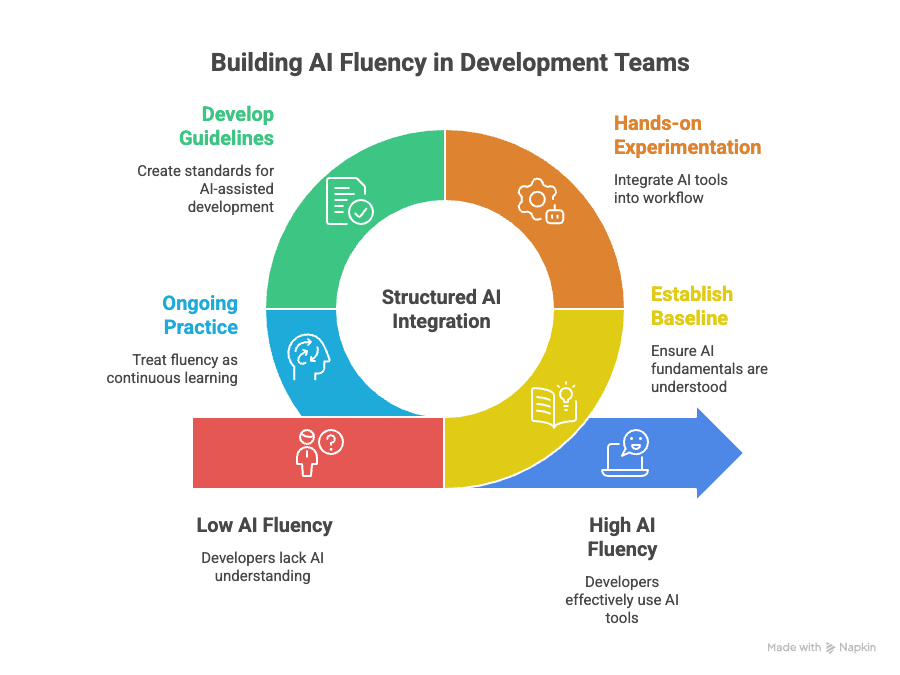
Start by establishing a shared baseline: Ensure that every member of your development team understands the fundamentals of how AI models work, including their strengths and limitations. This does not require deep technical knowledge of neural network architectures. It does require enough understanding to make informed decisions about when to trust AI output and when to question it.
Next, create structured opportunities for hands-on experimentation: Designate specific projects or sprints where developers are encouraged to integrate AI tools into their workflow and document what works and what does not. This creates institutional knowledge that benefits the entire team. Shopify’s approach is instructive here: the company’s internal policy effectively requires teams to demonstrate that they have explored AI augmentation before requesting additional headcount, which creates a strong organisational incentive to build fluency.
Invest in developing internal guidelines for AI-assisted development: These should cover tool selection, code review standards for AI-generated code, security and compliance requirements, and documentation practices. Having clear guidelines reduces friction, mitigates risk, and ensures that AI adoption happens in a controlled and productive manner.
Finally, treat fluency as an ongoing practice rather than a one-time achievement: Establish regular check-ins, share learnings across teams, and create channels for developers to flag new tools, techniques, and challenges as they emerge. The AI landscape will continue to evolve rapidly, and the organisations that build adaptive learning into their culture will be the ones that stay ahead.
The Human Skills That AI Fluency Amplifies
One of the most important insights to emerge from the AI fluency conversation is that technical AI skills alone are not enough. The professionals who are thriving in 2026 are those who combine technical fluency with distinctly human capabilities: critical thinking, creative problem-solving, clear communication, ethical reasoning, and the ability to collaborate across disciplines and contexts. That is a large part of what humans add on top of AI coding tools.
Gartner predictsthat 50% of organisations will require “AI-free” skills assessments by 2026, driven by concerns about the atrophy of critical-thinking skills due to over-reliance on generative AI. Fluency without judgment is not fluency at all.
The ability to think critically about AI outputs, to question assumptions, and to make decisions that account for context, nuance, and downstream consequences is what separates a truly fluent professional from someone who simply knows how to push a button.
| Metric | Insight | Source |
|---|---|---|
| 61% | Organisations prioritising leadership development in 2026 | Internal survey / industry projections |
| 71% | Employers rank emotional intelligence above technical ability | Industry report 2026 |
| 9/10 | Jobs requiring digital fluency + creative problem-solving by 2026 | Labor market forecast 2026 |
For development teams, this means that soft skills are not soft at all. The ability to communicate clearly about what an AI tool did and why, to explain technical decisions to non-technical stakeholders, to collaborate effectively with team members across time zones and cultures, and to exercise ethical judgment in situations where AI might produce outputs that are technically correct but contextually inappropriate: these are the capabilities that make AI fluency genuinely valuable.
The Path Forward
AI fluency is not a passing trend. It is the new professional baseline for anyone working in technology, and increasingly, for anyone working in knowledge-based roles of any kind. The data is clear: organisations that invest in building AI fluency across their workforce are outperforming those that do not. Professionals who develop and maintain AI fluency are earning more, advancing faster, and contributing more effectively to the organisations they serve.
For companies building remote development teams, this creates both a challenge and an opportunity. The challenge is ensuring that the developers you hire and the teams you build possess not just the technical foundations that have always been important, but also the AI fluency that is now equally essential. The opportunity is that by prioritising AI fluency, you can build teams that are not merely competent but genuinely exceptional, teams that combine deep technical skill with the judgment, adaptability, and strategic thinking that the AI era demands.
At RocketDevs, we believe that the best remote developers are not those who simply write code. They are professionals who think critically, learn continuously, communicate clearly, and adapt to new tools and paradigms with confidence and sophistication. In 2026, that description is inseparable from AI fluency. The developers who embrace this reality will be the ones who shape the future of software development. The ones who resist it will find that the future moves on without them.
About RocketDevs
RocketDevs connects companies with pre-vetted remote developers who combine world-class technical skills with exceptional communication and adaptability. Our comprehensive screening process ensures that every developer on our platform is equipped to deliver in the modern, AI-augmented development landscape. Learn more at rocketdevs.com.

Written by
Joy Atuzie
Growth Marketing Manager
I live at the intersection of search, content, and paid media. The work I do turns underperforming pages into traffic magnets, cold audiences into warm leads, and scattered marketing efforts into systems that actually compound over time.
More from our blog
Continue exploring insights and stories from RocketDevs