The Human Advantage: Why Developers Still Outperform AI
AI can write code fast, but it cannot replace judgment. Here is why developers still outperform AI, and what that means for who you should hire.


Table of contents
Artificial intelligence (AI) has transformed software development. Today, AI can generate code, build interfaces, write tests, and even create basic web applications from a simple prompt. With the enormous strides that AI is making in software development has left many wondering if human developers are still needed or if businesses can simply use AI alone.
The future of software development is not developers versus AI. It is developers working alongside AI.
In This Article:
- If AI can build software, do we still need developers?
- How building software is more than writing code.
- AI is fast, but speed isn't everything.
- Great developers think like architects.
- Human judgement can't be automated.
- Software is built for people.
- The best teams use AI as a multiplier.
- Hiring the right developers matters more than ever
- Looking for developers who know how to work with AI?
- Final Thoughts
If AI Can Build Software, Do We Still Need Developers?
AI has become remarkably good at writing code. Today, it can generate websites, build applications, fix bugs, and even create software from simple text prompts. This has led many people to ask an important question: if AI can build software, do we still need developers?
The short answer is yes. AI can produce code quickly, but writing code is only one part of software development. Successful software also requires planning, problem-solving, security, testing, performance optimisation, and an understanding of the people who will use it. These are areas where experienced developers continue to add enormous value.
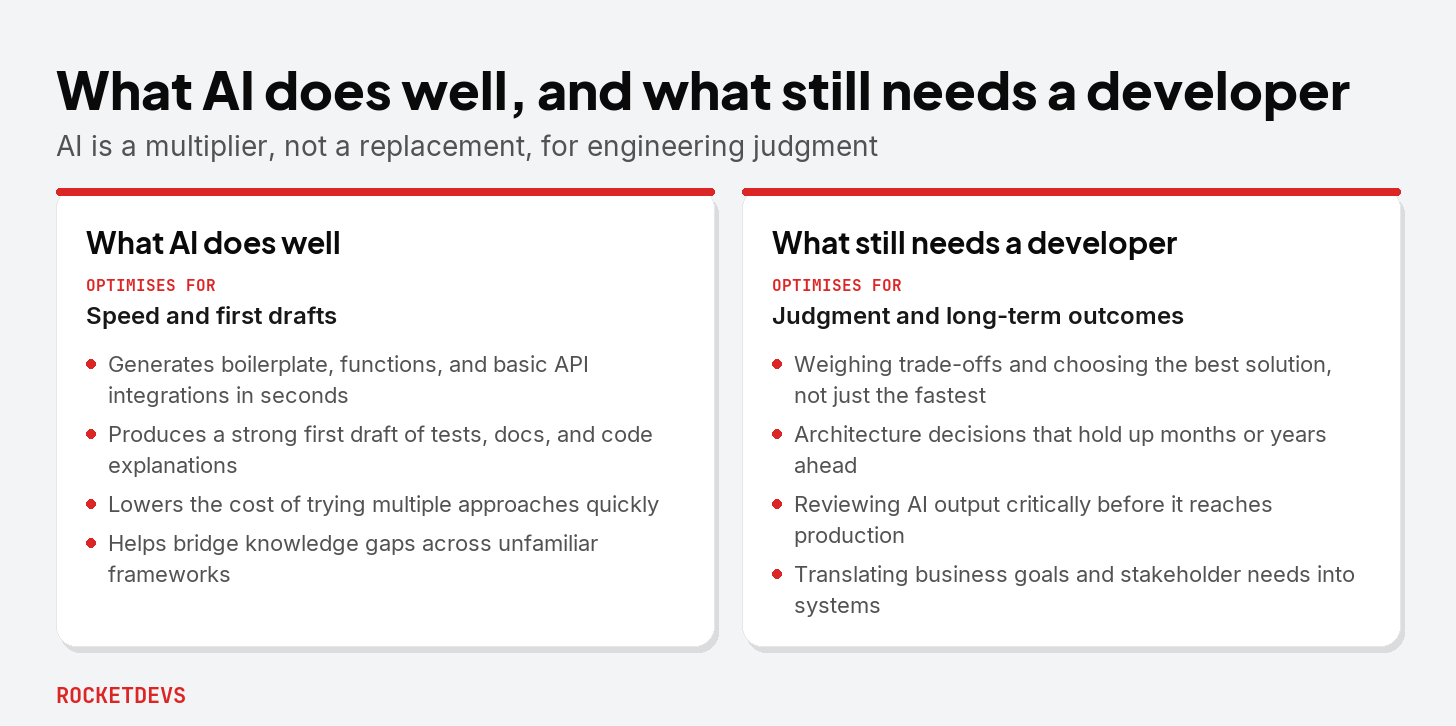
AI works by predicting the most likely solution based on existing patterns. It does not truly understand business goals, customer needs, or the long-term consequences of technical decisions. A skilled developer can weigh trade-offs (any situation where you must sacrifice one option, feature, or benefit to gain or improve another), challenge assumptions, and choose the best solution rather than simply the fastest one.
The future of software development is not developers versus AI. It is developers working alongside AI. The best engineers use AI to automate repetitive tasks, speed up development, and explore ideas more quickly. This allows them to spend more time on strategic thinking, creativity, and decision-making that AI cannot replace.
As AI becomes a standard development tool, the demand for talented developers is unlikely to disappear. Instead, the role is evolving. Companies still need professionals who can guide AI, review its output, maintain high-quality code, and build software that is secure, reliable, and designed to solve real-world problems.
How Building Software Is More Than Writing Code
Building software has always been about far more than writing code, and this becomes even more evident in the age of AI. While AI tools can now generate functions, build interfaces, and even assemble entire application scaffolds, they do so without a genuine understanding of context or intent. Software development involves translating messy, real-world problems into structured systems, which requires clarity of thinking, product understanding, and constant decision-making. AI can assist in producing code quickly, but it cannot independently define what should be built, why it matters, or how different technical choices will affect users and the business over time.
Beyond coding, software development includes architecture design, user experience considerations, testing strategies, security planning, and long-term maintenance. These are deeply human responsibilities that rely on judgment, collaboration, and experience. AI might suggest solutions, but it cannot reliably evaluate trade-offs in evolving systems or anticipate how software will scale under real-world constraints. Developers are still needed to guide the direction of the system, validate AI-generated output, and ensure that what gets built is not just functional, but also robust, efficient, and aligned with real user needs.
AI Is Fast, But Speed Isn't Everything
One of AI's biggest strengths is speed. Tasks that took hours can now be completed in minutes. But faster doesn't automatically mean better. AI often generates code that works but isn't necessarily the simplest or most maintainable solution. Left unchecked, this can lead to bloated applications, duplicated logic, unnecessary dependencies, and technical debt.
Experienced developers know that great software isn't measured by how much code it contains. It's measured by how effectively it solves the problem. Sometimes the best solution is writing less code, not more.
Great Developers Think Like Architects
Businesses rarely build software for today alone. Applications need to evolve. New features get added. Customer numbers grow. Security threats change. Regulations are updated. Developers have to think months or even years ahead. Every technical decision affects future costs, development speed, and product reliability. AI doesn't have a plan for the future. Developers do.
That's why experienced engineers focus on creating systems that are scalable, secure, and easy to maintain, not just systems that work today.
Human Judgment Can't Be Automated
Human judgment in software development cannot be fully automated. While AI tools can generate code quickly and even offer multiple possible solutions, they do not understand the deeper context behind a product, a business goal, or a user's real needs. This means that what looks like a correct solution on the surface may not actually align with the intended outcome. AI is useful for speed, but it does not replace the responsibility of deciding what is actually right.
In many cases, AI-generated code can introduce subtle problems. These might include security vulnerabilities, inefficient logic, or misunderstandings of the original requirements. Because AI models generate outputs based on patterns in data rather than real-world intent, they can confidently produce code that compiles and runs but still fail in critical ways. These issues are not always obvious at first glance, which makes careful review by a developer essential.
This is where experienced developers play a crucial role in Software Engineering. They don't just accept output at face value. Instead, they review it critically, test it under different conditions, and ask whether it truly solves the problem in a safe and scalable way. They also refine and restructure AI-generated code so that it fits into larger system architectures and long-term maintenance plans.
As AI becomes more deeply integrated into development workflows, the value of human judgment is increasing rather than decreasing. Businesses don't just need people who can write code, they need engineers who can evaluate it, challenge it, and improve it. The key distinction is no longer between writing code and not writing code, but between producing code and ensuring it is genuinely ready for production use.
Software Is Built for People
Software is ultimately built for people, not machines. At its core, every technology project exists to solve a human problem, improve a workflow, or create a better user experience. Because of this, development is never just a technical exercise. It is shaped by ongoing communication between developers and the people who understand the problem space, such as stakeholders, customers, and business teams.
Developers spend a large part of their work translating ideas into practical systems. This involves working closely with stakeholders to understand business goals and constraints. It also means collaborating with designers to ensure that interfaces are intuitive and easy to use. In addition, developers regularly engage with product teams to balance competing priorities, adjust scope, and make trade-offs between speed, quality, and functionality. These conversations are often where the most important decisions are made.
AI tools cannot fully participate in this kind of collaboration. They do not understand organisational context, shifting priorities, or the reasoning behind business decisions. They cannot ask clarifying questions in a meaningful way or negotiate changes when requirements evolve. Software projects rarely move in a straight line, and success depends on adapting to ambiguity and change, something that requires human communication and judgement.
Because of this, the most successful software products are built when technical skill is combined with strong interpersonal abilities. Clear communication, active listening, and the ability to collaborate across disciplines are just as important as writing efficient code. While AI can support implementation, it cannot replace the human relationships and shared understanding that guide a project from idea to completion.
The Best Teams Use AI as a Multiplier
AI becomes a multiplier when it is used to extend a developer's capabilities rather than replace decision-making. The developer still defines the problem, evaluates the output, and ensures quality, but AI increases the speed and breadth of what they can produce in the same amount of time.
The conversation should not be framed as "developers versus AI," but rather as "developers with AI." AI is most powerful when it is used as a multiplier of human skill, not a replacement for it. On its own, AI cannot build reliable, production-ready systems. But in the hands of a skilled engineer, it becomes a tool that dramatically increases speed, reach, and overall effectiveness.
When developers integrate AI into their workflow, routine tasks become significantly faster. Boilerplate code, repetitive functions, basic API integrations, and simple UI components can be generated in seconds rather than hours. This doesn't remove the need for developers. Rather, it shifts their focus away from repetitive implementation and toward higher-level design decisions. As a result, more time is spent thinking about system structure, user experience, and long-term maintainability.
AI also accelerates the supporting work around software development. Documentation, test generation, and code explanations can all be partially automated. Instead of writing everything manually, developers can generate a strong first draft and then refine it for accuracy and clarity. Testing becomes more scalable, with AI helping to identify edge cases or suggest missing scenarios that might otherwise be overlooked. This improves both speed and quality at the same time.
More importantly, AI expands what a single developer can realistically accomplish. It lowers the cost of experimentation, allowing engineers to try multiple approaches quickly before committing to a final solution. It also helps bridge knowledge gaps, making it easier to work across unfamiliar frameworks or languages. In this way, AI doesn't just make existing tasks faster, it increases the total surface area of what a developer can take on effectively.
The end result is not a reduction in the need for developers, but a shift toward higher-performing ones. Teams that use AI well are able to ship faster, iterate more often, and maintain higher standards of quality. The real advantage comes from combining human judgment with machine speed: developers define direction and make critical decisions, while AI amplifies their ability to execute.
Hiring the Right Developers Matters More Than Ever
Ironically, AI has made hiring stronger developers even more important. When anyone can generate code with AI, the real differentiator isn't coding speed - it's engineering judgment. Businesses need developers who know how to evaluate AI-generated code, improve it, secure it, and ensure it supports long-term business goals.
Those are the developers who create products that customers trust and businesses can confidently scale.
Looking for Developers Who Know How to Work with AI?
At RocketDevs, we believe AI should make great developers even better, not replace them.
Every developer on our platform is carefully vetted for technical ability, problem-solving skills, and engineering judgment. They know how to use modern AI tools to speed up development while ensuring the final product is secure, maintainable, and built to a high standard. Each developer goes through 6-8 hours of vetting, and fewer than 2% of applicants make it onto the platform, so you're hiring from the Top 2% at entry pricing from $9.99/hr, backed by a 14-day money-back trial, 100% honoured.
Whether you're building a new web application, launching a mobile app, or expanding your engineering team, RocketDevs connects you with developers who combine human expertise with the latest AI-powered workflows.
Because the future of software development isn't AI alone, it is exceptional developers empowered by AI.
Final Thoughts
AI is here to stay, and that's good news for software development.
Used well, it helps developers move faster and focus on higher-value work. It reduces repetitive tasks and improves productivity across engineering teams.
AI does not replace experience, accountability, or critical thinking required to build long-lasting software. The businesses seeing the greatest success aren't choosing between AI and developers; they're combining the efficiency of AI with the expertise of talented engineers. This combination is what builds software that performs well, scales confidently, and delivers lasting value.
Sources
- Fowler, M., "Technical Debt Quadrant"
- GitHub, "Research: quantifying GitHub Copilot's impact on developer productivity and happiness" (2022)
- Microsoft Research, "The Impact of AI on Developer Productivity: Evidence from GitHub Copilot"
- McKinsey & Company, "The economic potential of generative AI: The next productivity frontier" (2023)
- Stanford HAI, "AI Index Report"
- Stack Overflow, "2025 Developer Survey"
- World Economic Forum, "The Future of Jobs Report 2023"
- OpenAI, "GPT-4 Technical Report" (2023)
- Deloitte, "The Future of Software in the Age of AI"
- Accenture, "Reinvention in the Age of Generative AI"
- Google Research, "Software Engineering and Programming Languages"
- IEEE Computer Society, "Guide to the Software Engineering Body of Knowledge (SWEBOK)"
- Brooks, F.P., "The Mythical Man-Month: Essays on Software Engineering" (1975)
- Evans, E., "Domain-Driven Design: Tackling Complexity in the Heart of Software" (2003)
James Hitch, COO at RocketDevs Last updated: 2026-07-15

Written by
James Hitch
COO
James Hitch is the COO of RocketDevs, where he runs sales, recruiting, and the vetting operation that accepts only the top 2–3% of developer applicants. He cares about putting accessible, elite engineering talent within reach of founders and startups worldwide, at a fair price. He writes about technical hiring, building AI-native engineering teams, and how startups can access elite developers affordably.
More from our blog
Continue exploring insights and stories from RocketDevs