The AI Technical Debt Crisis: Why the Fastest Codebases in 2026 Are Becoming the Most Fragile
The AI Technical Debt Crisis: Discover why faster AI-generated code in 2026 is creating fragile, hard-to-maintain systems and how hidden complexity is compounding faster than teams can manage.


Something paradoxical is happening inside the world’s fastest-moving engineering organisations. Teams are shipping features at record speed, commit volumes are up by triple digits, and AI coding tools are generating an ever-growing share of production code. By every surface-level metric, software development has never been more productive.
And yet, under the surface, a different story is unfolding. Codebases are expanding faster than the teams building them can comprehend. Debugging cycles are growing longer, not shorter. Security vulnerabilities are multiplying. And a new category of risk, one that does not register on any traditional dashboard, is accumulating silently in repositories across every industry. This is closely tied to why AI agents ship more code than teams can maintain.
Welcome to the AI technical debt crisis of 2026.
| Metric | Insight |
|---|---|
| 41% | Of all new commercial code is now AI-generated |
| 39% | Increase in code churn in AI-heavy projects (GitClear) |
| 75% | Of tech leaders projected to face moderate to severe debt problems by 2026 (Forrester) |
This is not an argument against AI in software development. The productivity gains are real and, when managed well, transformative. But the industry is rapidly discovering that generating code and maintaining code are fundamentally different challenges, and that optimising for the former without governing the latter is a recipe for compounding fragility.
The Speed Trap: How AI Made the Fast Part Faster and the Hard Parts Harder
The core tension is straightforward. AI coding tools are extraordinarily good at producing functional code quickly. They can scaffold entire components, generate boilerplate, and translate natural language specifications into working implementations in seconds. For individual tasks, the velocity gains are undeniable.
But writing code has never been the bottleneck in professional software development. Understanding code is. Debugging code is. Modifying code that someone else wrote, or that was generated by a model whose reasoning you cannot inspect, is. AI has made the fast part of development faster while making the slow parts measurably slower.
A recent analysis of developer productivity found that while developers feel approximately 20% faster when using AI tools, they actually measure 19% slower when accounting for the full development lifecycle. The gap between perceived velocity and actual throughput is one of the defining characteristics of the current moment in software engineering.
AI coding tools write 41% of all new commercial code in 2026. Velocity has never been higher. Yet experienced developers report a 19% productivity decrease when using AI tools, according to Stack Overflow analysis.
The disconnect arises because AI-generated code, even when it functions correctly, often lacks the architectural coherence, contextual awareness, and adherence to project-specific conventions that experienced human developers bring to their work. It compiles, it passes tests, and it ships. But it does not necessarily integrate cleanly into the broader system, and it does not carry with it an explanation of why it was written the way it was.
Recommended: How Much Does It Cost to Hire an App Developer in 2025?
Beyond Technical Debt: The Rise of Comprehension Debt
The software industry has understood technical debt for decades: shortcuts taken in code that accumulate interest over time, eventually requiring dedicated effort to pay down. What is emerging in 2026 is something qualitatively different and, in many ways, more dangerous.
Google engineer Addy Osmani coined the term comprehension debt to describe the growing gap between how much code exists in a system and how much of it any human being genuinely understands. Unlike traditional technical debt, which announces itself through friction, slow builds, and tangled dependencies, comprehension debt breeds false confidence. The codebase looks clean. The tests pass. The velocity metrics look excellent. And then, one day, the team discovers they can no longer safely modify their own system.
Researcher Margaret-Anne Storey documented this phenomenon with a student team that hit a wall seven weeks into a project. The problem was not messy code. It was that no one on the team could explain why design decisions had been made or how different parts of the system were supposed to work together. The shared theory of the software had evaporated.
This is the mechanism by which AI-generated code creates risk that traditional tooling cannot detect. Every time a developer approves an AI-generated pull request without building a genuine mental model of how the code works, comprehension debt increases. When this happens across an entire team, across hundreds of pull requests, the cumulative effect is a codebase that functions today but that no one can confidently modify tomorrow.
| Dimension | Traditional Technical Debt | AI-Driven Comprehension Debt |
|---|---|---|
| How it accumulates | Conscious shortcuts, deferred refactoring | Silently, through approved code no one fully understands |
| Visibility | Shows up as friction, slow builds, bugs | Invisible behind green test suites and high velocity metrics |
| Detection | Linters, static analysis, code reviews | No standard tooling exists to measure it |
| Paydown strategy | Allocate a sprint, refactor the code | Requires rebuilding shared understanding, not just refactoring |
| Compounding rate | Linear | Exponential, accelerated by AI code volume |
The Data Behind the Debt
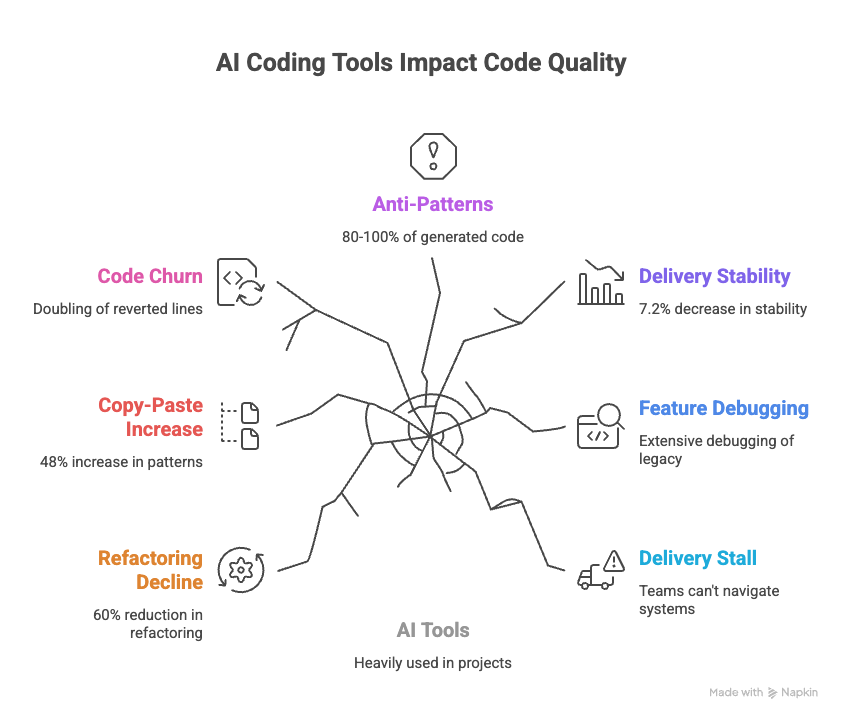
The empirical evidence is mounting rapidly. An analysis by GitClear of over 211 million lines of changed code found that projects heavily using AI coding tools showed a 60% decline in refactored code, a 48% increase in copy-paste patterns, and a doubling of code churn, the percentage of lines reverted or substantially modified within two weeks of being written.
Ox Security’s analysis of more than 300 repositories identified ten recurring anti-patterns present in 80% to 100% of AI-generated code, including incomplete error handling, weak concurrency management, and inconsistent architecture. The research characterised AI-generated output as functionally competent but systematically lacking in architectural judgment.
Google’s 2024 DORA report confirmed the trade-off: a 25% increase in AI tool usage accelerated code reviews and improved documentation, but produced a 7.2% decrease in delivery stability. The gains were real, but they came with a cost that most teams were not tracking.
Perhaps most sobering is the 18-month pattern that multiple teams have reported. The first three months of AI-assisted development produce euphoric velocity gains. Months four through nine see a plateau as integration challenges emerge. By months ten through fifteen, new features require extensive debugging of AI-generated legacy components. And by months sixteen through eighteen, delivery cycles stall because teams can no longer confidently navigate their own systems.
| Metric | Insight |
|---|---|
| 60% | Decline in refactored code in AI-heavy projects (GitClear) |
| 48% | Increase in copy-paste patterns with AI tools |
| 4x | Maintenance costs by year two of unmanaged AI code |
Why Code Review Is Breaking Down
One of the critical mechanisms by which technical and comprehension debt are managed in traditional development is code review. A senior engineer reads a junior’s pull request, identifies issues, explains why the approach is wrong, and both parties learn something. This feedback loop has been a cornerstone of software quality and developer mentorship for decades.
AI-assisted development is fundamentally disrupting this loop. In a traditional workflow, a junior developer might submit a pull request with 50 lines of code. The reviewer can read it carefully, identify logic errors, and provide meaningful feedback. In an AI-augmented workflow, the same developer submits 500 lines of AI-generated code. The code is syntactically clean, follows linting rules, and uses descriptive variable names. But verifying whether it is actually correct, checking for race conditions, edge cases, and security vulnerabilities, requires the reviewer to mentally reconstruct the entire logic flow.
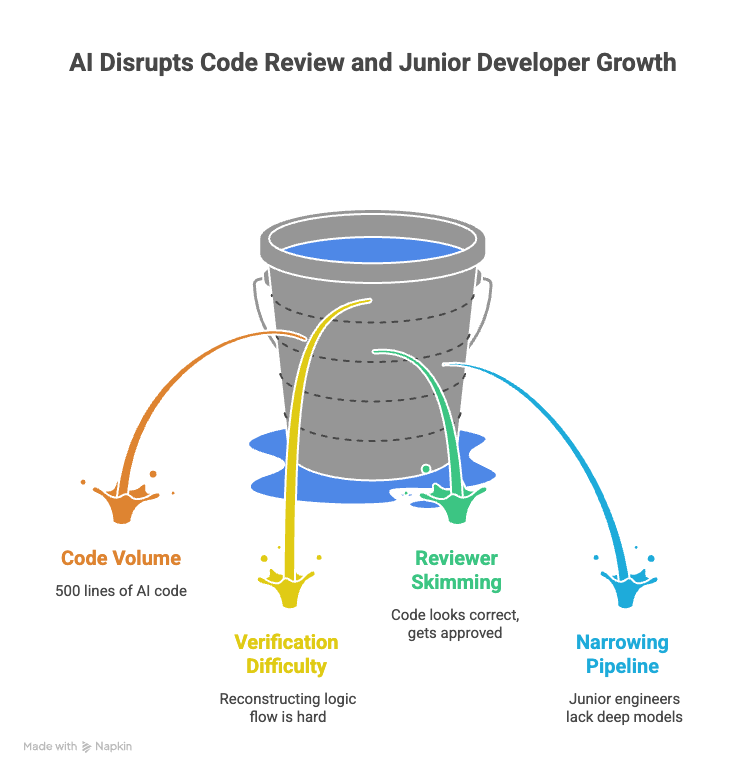
Most reviewers do not do this. When code looks correct, the brain skims. The pull request gets approved. The debt gets merged. And the feedback loop that once served as both quality gate and mentorship mechanism erodes.
This has profound implications for the development of junior engineers. If the tasks that once defined their learning path, writing code, struggling with implementation details, making mistakes and being corrected, are delegated to AI, the pipeline that produces senior engineers begins to narrow. The industry risks raising a generation of developers who can generate code rapidly but who lack the deep mental models required to debug, architect, and maintain complex systems.
Best Read: Before You Hire: 20 Good Questions to Ask a Vue Frontend Developer
The Governance Gap: Why Most Teams Are Measuring the Wrong Things
The fundamental problem is measurement. Most engineering organisations track velocity, commit counts, features shipped, and sprint completion rates. AI tools excel at inflating these metrics. What they do not track, and what AI tools do not improve, are the indicators that matter for long-term software health: code comprehensibility, architectural coherence, dependency hygiene, and the team’s collective understanding of the systems they maintain.
As one analyst put it: “The uncomfortable reality is that most companies are optimising for the wrong metrics. They are measuring AI adoption rates and feature velocity while ignoring technical debt accumulation.”
Gartner has projected that 40% of AI projects will face cancellation by 2027 due to escalating costs and weak risk controls. The organisations most likely to find themselves in this position are those that adopted AI coding tools aggressively without simultaneously updating their quality assurance processes, code review standards, and architectural governance frameworks.
The teams that are winning in 2026 are not the ones generating the most code. They are the ones generating the right code, and they have invested in the governance structures to ensure that AI output meets their standards for quality, security, and maintainability.
What High-Performing Teams Are Doing Differently
Establishing architectural guardrails before AI writes a line: Leading teams define Architectural Decision Records that specify their system’s non-negotiables: security boundaries, data isolation requirements, performance thresholds, and coding conventions. These guardrails constrain AI output to patterns that are compatible with the existing system.
Treating AI output as a draft, not a deliverable: The most disciplined teams apply the same scrutiny to AI-generated code that they would apply to a pull request from a talented but inexperienced junior developer. The code may be functionally correct, but correctness alone is not the standard. Architectural coherence, security, maintainability, and consistency with project conventions matter equally.
Investing in comprehension, not just velocity: This means requiring developers to build and articulate mental models of the code they approve. Some teams have introduced “explain the PR” sessions where the person who approved an AI-generated pull request must walk through its logic for the team. This slows things down slightly but dramatically reduces comprehension debt.
Maintaining the junior-to-senior pipeline: Rather than eliminating entry-level coding tasks, forward-thinking teams are redefining them. Junior developers focus on evaluating and testing AI-generated code, fine-tuning prompts for specific codebases, and identifying where AI output fails to meet quality standards. The tasks have changed, but the learning continues.
Tracking debt-specific metrics: Code churn rates, the ratio of reverted to committed code, and time-to-resolve for bugs in AI-generated components are all indicators that teams can track today. The organisations that build these metrics into their dashboards alongside velocity metrics are the ones best positioned to manage AI’s long-term impact on their codebases.
Top Read: Founding Engineer vs CTO: Key Differences & Similarities
Why Developer Quality Matters More Than Ever
The AI technical debt crisis is not fundamentally a technology problem. It is a people problem. The difference between a team that uses AI to ship better software faster and a team that uses AI to accumulate invisible risk comes down to the judgment, discipline, and architectural skill of the developers involved.
This is why the quality of the developers on your team has never mattered more. In a world where AI can generate functional code at scale, the bottleneck is no longer production. It is evaluation. The developers who will thrive in this environment are those who can critically assess AI output, who understand the architectural implications of the code they approve, who communicate clearly about trade-offs and risks, and who bring the kind of deep systems thinking that no AI tool currently replicates. That is precisely where human developers still beat AI.
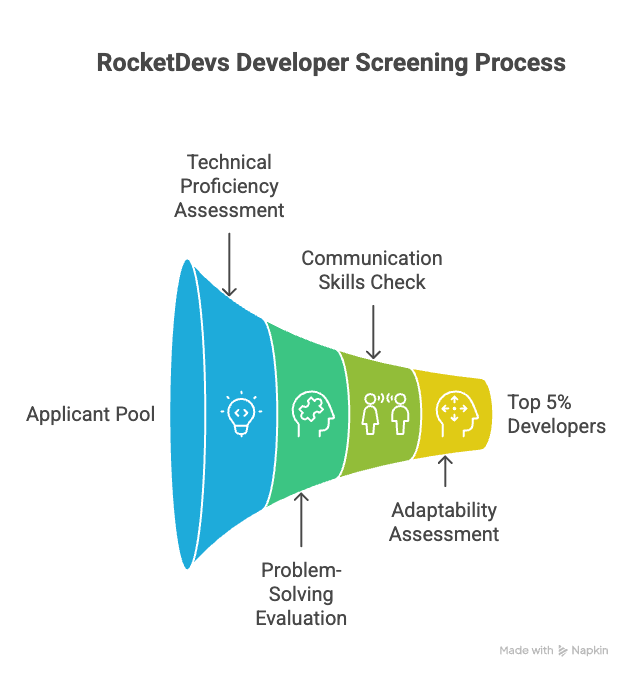
This is where the model that platforms like RocketDevs pioneered becomes especially relevant. RocketDevs’ approach has always centred on identifying developers who are not just technically proficient but who demonstrate strong problem-solving abilities, clear communication, and adaptability, qualities assessed through a comprehensive 6-8 hour screening process that accepts only the top 5% of applicants. In an era where AI is amplifying both the opportunities and the risks of software development, these qualities are the difference between a team that harnesses AI effectively and one that drowns in the debt it creates.
The transparency model that RocketDevs has built into its platform, including detailed vetting results, time-tracking dashboards, and direct communication channels, becomes especially valuable in this context. When AI is handling more of the raw code generation, understanding how your developers are spending their time, how they are evaluating AI output, and how rigorously they are maintaining architectural standards matters far more than counting lines of code.
The Competitive Implications
The AI technical debt crisis is creating a divergence in the industry that will widen significantly over the next two to three years. Organisations that get the governance right, that combine AI augmentation with rigorous quality standards and skilled developers, will ship faster and build more durable systems. Their AI tools will compound value.
Organisations that pursue velocity without governance will find themselves increasingly trapped. Their codebases will grow larger but less comprehensible. Their maintenance costs will escalate. Their ability to respond to changing requirements will erode. Their AI tools will compound debt.
The irony of the AI technical debt crisis is this: the better your codebase, the more value you extract from AI. The worse your codebase, the more damage AI inflicts on it. AI amplifies whatever is already there. Strong foundations get amplified into faster, more reliable delivery. Weak foundations get amplified into faster debt accumulation.
Looking Ahead
The AI technical debt crisis is not a reason to reject AI-assisted development. The productivity gains are real, and the technology will continue to improve. It is, however, a powerful argument for treating AI as a tool that requires governance, not a shortcut that eliminates the need for it. The same discipline applies when AI enters hiring, as this look at the guardrails AI needs when it enters real workflows shows.
The developers and organisations that will define the next era of software are not those who generate the most code or who adopt AI tools the fastest. They are the ones who combine the speed of AI with the judgment, discipline, and architectural thinking that ensures what gets built today can be maintained, extended, and trusted tomorrow.
In 2026, the most valuable developer is not the one who writes the most code. It is the one who knows what code not to write, and who can ensure that the code AI does write meets the standards that durable software demands.
About RocketDevs
RocketDevs connects companies with pre-vetted remote developers who combine world-class technical skills with exceptional communication and adaptability. Our comprehensive screening process ensures that every developer on our platform is equipped to deliver in the modern, AI-augmented development landscape. Learn more at rocketdevs.com.

Written by
Joy Atuzie
Growth Marketing Manager
I live at the intersection of search, content, and paid media. The work I do turns underperforming pages into traffic magnets, cold audiences into warm leads, and scattered marketing efforts into systems that actually compound over time.
More from our blog
Continue exploring insights and stories from RocketDevs