From Builders to Conductors: How AI Is Reshaping Software Development, According to the Industry's Most Powerful Voices
See how AI is transforming software development in 2026, shifting roles from builders to conductors, with insights from the industry's leading experts.


Table of contents
Something unusual happened at the World Economic Forum in Davos in January 2026. The CEOs of the world’s most influential technology companies, people not known for agreeing on much, converged on a strikingly similar message: the way software is built is transforming so fundamentally that the very definition of what it means to be a developer is being rewritten in real time.
| Metric | Insight | Source |
|---|---|---|
| 20-30% | Microsoft’s code is now AI-generated | Satya Nadella |
| 25%+ | Google’s new code AI-generated | Sundar Pichai |
| 84% | Developers now using AI tools | Stack Overflow |
Anthropic CEO Dario Amodei told the Davos audience that AI could be capable of handling most, perhaps all, of the coding work done by software engineers within six to twelve months. He noted that some engineering leads within his own company have essentially stopped writing code themselves, relying instead on AI to generate it while they focus on reviewing, directing, and refining. NVIDIA CEO Jensen Huang, speaking at London Tech Week, declared that a new programming language had arrived, and that language was simply human. Microsoft CEO Satya Nadella confirmed that between 20% and 30% of Microsoft’s internal code was already being generated by AI, and the company’s CTO predicted that figure could reach 95% by the end of the decade. Google CEO Sundar Pichai reported similar numbers, with more than a quarter of Google’s new code being AI-generated.
These are not speculative projections from futurists on the conference circuit. These are operational realities being described by the people running the companies that build the world’s software infrastructure. When the heads of Anthropic, Microsoft, NVIDIA, and Google all point in the same direction, it is worth paying very close attention.
The Predictions That Launched a Thousand Debates
The conversation arguably began in earnest in March 2025, when Amodei told an audience at the Council on Foreign Relations that AI would be writing 90% of code within three to six months and potentially all of it within a year. The prediction sparked fierce debate across the technology industry. Some dismissed it as self-serving hype from the CEO of an AI company. Others, particularly developers working hands-on with AI coding tools, recognised it as an acceleration of trends they were already experiencing in their daily work.
“I think we’ll be there in three to six months, where AI is writing 90% of the code. And then in twelve months, we may be in a world where AI is writing essentially all of the code.”
– Dario Amodei, CEO of Anthropic (March 2025)
By mid-2025, the picture had become clearer, though the reality landed somewhere between the boldest predictions and the most dismissive critiques. AI was not writing 90% of the world’s code. But it was generating a significant and rapidly growing proportion of code inside the world’s largest technology companies. The Stack Overflow 2025 Developer Survey found that 84% of developers were now using AI tools in their work, a massive increase from just a couple of years prior. GitHub reported a 25% year-over-year increase in code commits in 2025, a surge attributed largely to AI integration. The technology was not replacing developers overnight, but it was fundamentally changing what developers spend their time doing.
“I have engineers within Anthropic who say I don’t write any code anymore.”
– Dario Amodei, CEO of Anthropic (Davos, January 2026)
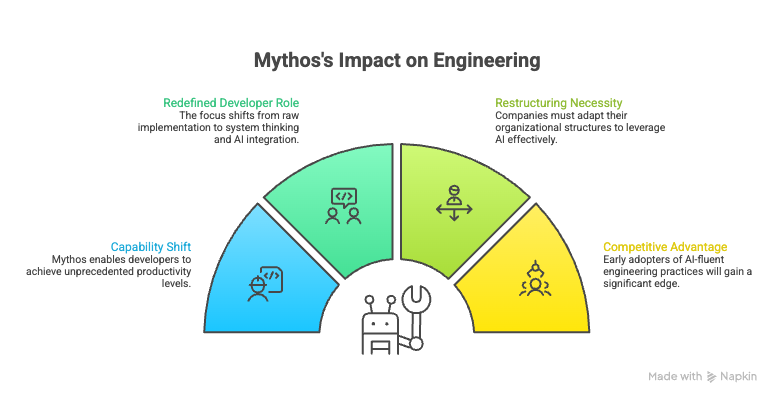
When Amodei returned to the subject at Davos in January 2026, his framing had evolved. He spoke less about percentages and more about the shift in the developer’s role. The engineers at Anthropic who had stopped writing code had not stopped engineering. They had shifted from being primarily builders, people who translate logic into syntax, to being primarily conductors, people who direct, evaluate, and orchestrate the output of AI systems. The distinction is not merely semantic. It represents a profound change in what it means to do this work.
What the Data Actually Shows
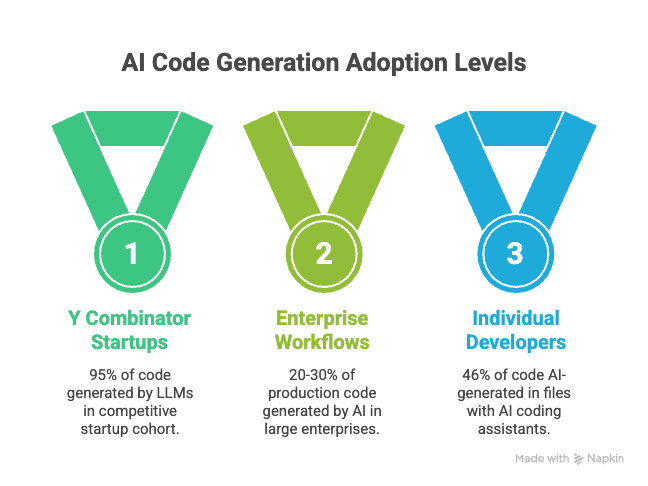
It is useful to separate the rhetoric from the data, because the data tells a nuanced and instructive story. At the enterprise level, AI-generated code is already a significant part of production workflows. Microsoft’s 20-30% figure, confirmed by Nadella at Meta’s LlamaCon conference in April 2025, represented production code in real repositories, not experimental output. Nadella noted that the company was seeing particularly strong results in Python, with less progress in more complex languages like C++. Google’s numbers were comparable.
At the individual developer level, the picture is more varied. GitHub’s data from 2024 and 2025 showed that in files where AI coding assistants were active, roughly 46% of the code was AI-generated, with suggestion acceptance rates around 30% in enterprise settings. That is a far cry from 90%, but it represents a dramatic shift from zero just a few years ago.
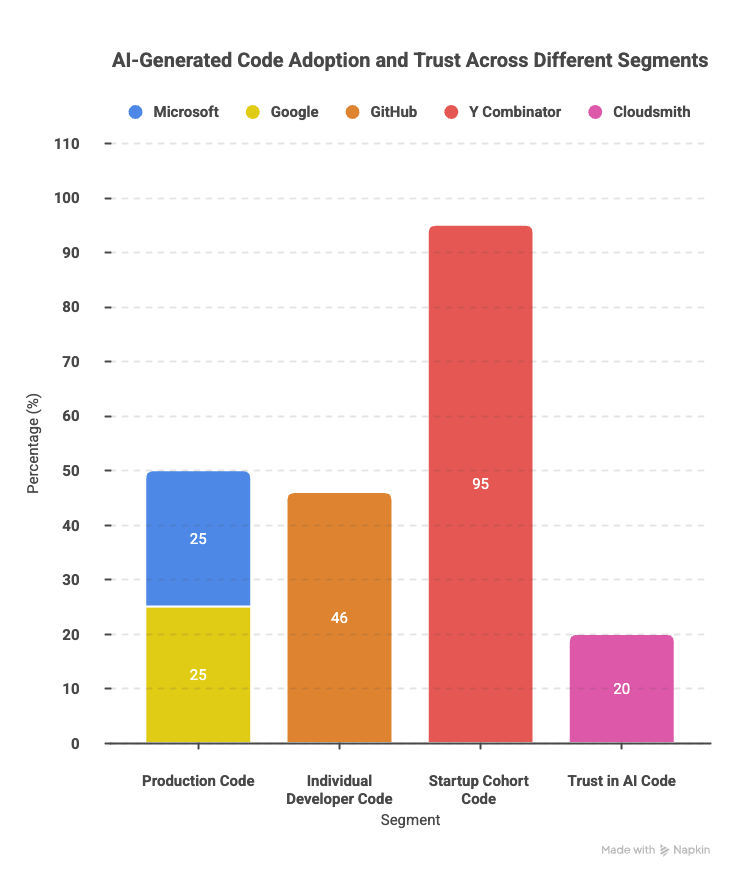
Perhaps most telling is what happened with Y Combinator’s Winter 2025 startup cohort. Garry Tan, Y Combinator’s president and CEO, reported that 25% of the founders in that batch were relying heavily on AI, with 95% of their code generated by large language models. These were not hobbyists experimenting on side projects. They were founders building real companies with real products, shipping to real customers. The fact that a quarter of one of the world’s most competitive startup cohorts was built primarily with AI-generated code is arguably a more powerful signal than any CEO prediction.
Research from Cloudsmith found that around 42% of developers reported having AI-generated code in their codebases. But the trust question remained significant: only 20% of developers said they trusted AI-generated code completely. The majority treated AI output as a draft that required human review, testing, and refinement. This aligns with what David Heinemeier Hansson, creator of Ruby on Rails, has argued: AI coding tools do not yet match the reliability of experienced human developers, and their output is inconsistent enough to require substantial oversight.
Recommended: Product Hunt Launch: How These 15 Companies Got #1 in 2025
The Role of the Developer Is Changing, Not Disappearing
The most important insight to emerge from this period is not about replacement. It is about transformation. The developer role is not vanishing. It is evolving, rapidly and in ways that have significant implications for how companies build, manage, and hire technical teams.
Jensen Huang’s framing is useful here. At London Tech Week in mid-2025, the NVIDIA CEO argued that coding itself is just one task within the broader discipline of software engineering, not the purpose of the job. He encouraged engineers to focus on solving deeper problems and driving innovation, treating AI as the tool that handles the mechanical translation of ideas into code. Amodei made a similar point at Davos, noting that developers still need to specify requirements, make architectural decisions, evaluate security implications, and collaborate with other systems and teams. The programmer still sets direction. AI handles more of the execution.
“There’s a new programming language. It is called ‘human.’”
– Jensen Huang, CEO of NVIDIA (London Tech Week, June 2025)
Nadella’s perspective added another dimension. Speaking in early 2026, he argued that AI has effectively lowered the barrier to entry for software development to the point where “anyone can be a software developer.” This might sound threatening to professional developers, but Nadella’s point was more subtle. Practices like “vibe coding,” where non-technical workers build applications using natural language prompts, have expanded what is possible, but they have not eliminated the need for deep technical skill.
Someone who can build a prototype with AI prompts is not the same as someone who can architect a system that scales, handles edge cases, maintains security, and integrates with existing infrastructure. The former has become easier. The latter remains as demanding as ever, and arguably more so.
“Anyone can be a software developer.”
– Satya Nadella, CEO of Microsoft (March 2026)
The Instagram co-founder, Mike Krieger, captured another facet of this shift: developers, he suggested, will increasingly spend more time reviewing code than writing it. This observation aligns with what many working developers report. AI coding tools generate first drafts quickly, but the real work lies in evaluating whether that draft is correct, secure, performant, and maintainable. The skill set required for that evaluation is, if anything, more sophisticated than the skill set required to write the code from scratch.
THE DEVELOPER ROLE: BEFORE AI VS. WITH AI
| Dimension | Pre-AI Developer | AI-Era Developer |
|---|---|---|
| Primary activity | Writing code from scratch | Directing, reviewing, and refining AI-generated code |
| Value proposition | Translation of logic into syntax | Judgment, architecture, and systems thinking |
| Quality control | Peer code review | AI output review + peer review + security audit |
| Speed bottleneck | Typing and implementation speed | Decision-making speed and review thoroughness |
| Learning focus | New languages and frameworks | AI tool fluency + deepening architectural judgment |
| Collaboration model | Human-to-human only | Human-to-AI-to-human orchestration |
What This Means for Remote Development Teams
For companies that build products with remote development teams, these shifts create both challenges and opportunities that are worth examining carefully.
The challenge is that the bar for what constitutes a genuinely capable developer has risen. Technical proficiency with a particular language or framework is no longer sufficient on its own. The modern developer also needs to demonstrate fluency with AI-assisted development workflows, the ability to critically evaluate AI-generated code, strong architectural and systems thinking, and the communication skills to work effectively as part of a distributed team that increasingly includes AI as a collaborator.
The opportunity is that AI augmentation, when combined with skilled developers, produces a multiplier effect on productivity that is difficult to achieve through headcount alone. A well-structured team of AI-fluent developers can accomplish work that would previously have required a significantly larger team. This is particularly powerful for startups and growing companies that need to move quickly with limited resources.
This is where the model that platforms like RocketDevs pioneered becomes especially relevant. RocketDevs’ approach has always centred on identifying developers who are not just technically proficient but who demonstrate strong problem-solving abilities, clear communication, and adaptability – qualities assessed through a comprehensive screening process that goes well beyond algorithmic tests. In an era where AI is reshaping what developers do, these qualities matter more than ever.
The transparency model that RocketDevs has built into its platform, including detailed vetting results, time-tracking dashboards, and direct communication channels, also becomes more valuable in this context. When AI is handling more of the raw code generation, understanding how your developers are spending their time, how they are evaluating and refining AI output, and how effectively they are translating requirements into working software becomes even more important than tracking lines of code written.
Top Read: Review: App Development for Startups at Garage2Global (2025)
The Junior Developer Question
One of the most debated aspects of the AI-in-development conversation concerns junior developers. Amodei has spoken directly about this, suggesting that tasks traditionally assigned to junior engineers are among the first to be automated by AI systems. This has led to widespread concern about whether entry-level development positions will continue to exist in meaningful numbers.
The concern is understandable, but the picture is more complex than a simple narrative of elimination. What is happening is a restructuring of the entry point into the profession. The tasks that defined junior development work five years ago, writing boilerplate code, implementing well-defined features from specifications, fixing straightforward bugs, are increasingly handled by AI. But new categories of entry-level work are emerging: evaluating and testing AI-generated code, fine-tuning prompts for specific codebases and use cases, managing AI tool configurations, and identifying cases where AI output fails to meet quality, security, or performance standards.
The implication for hiring is that the definition of “junior developer” needs to evolve. Companies should be looking for candidates who bring not just foundational coding skills but also the critical thinking, attention to detail, and adaptability that effective AI-augmented development requires. The developers who enter the profession through this new path may have a different skill profile than their predecessors, but they will be no less essential.
Separating Signal from Hype
It is worth acknowledging that not every prediction from a technology CEO should be taken at face value. The heads of AI companies have a natural incentive to promote the capabilities and trajectory of the technology they sell. Amodei’s March 2025 prediction that AI would be writing 90% of code within six months did not materialise in the sweeping, industry-wide fashion the headlines suggested. The LessWrong community conducted a detailed analysis of the claim and concluded that while AI code generation within Anthropic and a handful of other leading companies had indeed expanded dramatically, the prediction had not been borne out across the industry as a whole.
This does not mean the underlying trend is overstated. It means that the timeline for widespread transformation is longer than the most aggressive predictions suggest, while still being significantly shorter than sceptics might prefer. The direction of travel is clear and consistent across every credible data source: AI is writing a larger share of code every quarter, developers are spending more time directing and reviewing AI output, and the skills required to do this work effectively are evolving.
The practical takeaway for companies and developers is that preparing for this shift is not optional, but panic is not warranted either. The developers who invest in building AI fluency, who approach AI tools with both enthusiasm and critical judgment, and who continue to deepen their core engineering skills will find themselves more valuable, not less, in the years ahead.
The Competitive Advantage of Getting This Right
For companies building products with remote developers, the competitive implications of this shift are significant. Organisations that equip their development teams to work effectively with AI tools will ship faster, produce more robust code, and achieve more with smaller teams. Those that lag behind will find themselves competing against companies whose developers are effectively augmented by AI, a contest that will become increasingly lopsided over time.
| Metric | Insight | Source |
|---|---|---|
| 1.1B | Jobs to be transformed by technology this decade | WEF |
| 25% | Year-over-year increase in GitHub code commits (2025) | GitHub data 2025 |
| 4x | Productivity growth in AI-exposed industries | PwC |
The World Economic Forum estimates that approximately 1.1 billion jobs could be transformed by technology over the next decade. The organisations that treat this transformation as an opportunity, investing in their teams’ capabilities, updating their hiring criteria, and building workflows that leverage AI augmentation effectively, will be the ones that thrive.
This is why the combination of skilled, thoroughly vetted developers and AI augmentation is so powerful. A developer sourced through a rigorous screening process, someone with strong fundamentals, clear communication, and demonstrated adaptability, is exactly the person who will extract the most value from AI coding tools. The tool provides leverage. The developer provides judgment, context, and the ability to ensure that what gets built actually serves the user.
Looking Ahead
The transformation of software development is not a future event. It is happening now, in real codebases, at real companies, with real implications for everyone involved in building software. The pronouncements from Amodei, Huang, Nadella, and Pichai are not predictions so much as descriptions of a process already underway.
The developers who will define the next era of software are not those who write the most code or who resist AI the most stubbornly. They are the ones who combine deep technical understanding with the fluency, judgment, and adaptability to work effectively in a world where AI is a collaborator, not a competitor. They are the developers who understand that their value lies not in typing speed but in thinking quality.
At RocketDevs, we have always believed that the best developers are more than just coders. They are problem-solvers, communicators, and strategic thinkers who happen to express their work through software. In 2026, the AI revolution has not changed that belief. It has validated it. The developers on our platform are equipped not just to write code, but to lead, evaluate, and architect in an environment where AI handles more of the execution and humans provide more of the direction. That is the future of software development. And it is already here.
About RocketDevs
RocketDevs connects companies with pre-vetted remote developers who combine world-class technical skills with exceptional communication and adaptability. Our comprehensive screening process ensures that every developer on our platform is equipped to deliver in the modern, AI-augmented development landscape. Learn more at rocketdevs.com.

Written by
Joy Atuzie
Growth Marketing Manager
I live at the intersection of search, content, and paid media. The work I do turns underperforming pages into traffic magnets, cold audiences into warm leads, and scattered marketing efforts into systems that actually compound over time.
More from our blog
Continue exploring insights and stories from RocketDevs