Top Arc.dev Alternatives for Startups in 2026
Arc.dev's AI matching is fast, but the screening still lands back on you. Here are the best Arc.dev alternatives for startups in 2026, compared honestly.


Table of contents
Finding skilled developers is no longer the biggest challenge for startups. The real challenge is finding developers who can deliver high-quality work without spending weeks reviewing applications, running technical interviews, and filtering out unsuitable candidates. While platforms like Arc.dev have made sourcing talent faster through AI-powered matching, many founders still find themselves investing significant time evaluating the developers they are shown before they can make a confident hiring decision.
As a result, many startups are exploring alternatives that better fit their hiring process. Some platforms focus on generating qualified candidates as quickly as possible, while others place greater emphasis on rigorous technical vetting before candidates are ever presented to clients. The right choice depends on what matters most to your business: speed, cost, quality, or reducing the amount of hiring work your team has to do.
This guide compares the top Arc.dev alternatives for startups in 2026. We'll explain why founders look beyond Arc.dev, how its AI-powered matching process works, how competing platforms differ in their vetting and pricing models, what factors matter beyond hourly rates, and which platform is the best fit for different types of startup founders.
In this article
- Why do founders look for an Arc.dev alternative?
- How does Arc's AI-matching pipeline actually work?
- What are the best Arc.dev alternatives in 2026?
- What should you compare beyond the hourly rate?
- Which alternative fits which kind of founder?
Why do founders look for an Arc.dev alternative?
Arc.dev is designed to help companies find developers quickly. According to its pricing page, the platform searches a global talent pool of more than 20 million candidates, with freelance rates starting at around $15 per hour and full-time hires carrying a placement fee of 20% of the developer's annual salary. Its AI-powered matching system can rapidly identify candidates whose skills and experience align with a job description.
However, matching candidates is only one part of the hiring process. While Arc.dev's AI can filter and rank developers based on their profiles, it does not verify that they can perform the work in a real-world setting. Technical interviews, coding assessments, and final hiring decisions still rest with the employer.
An independent 2026 review by Highcircl found that founders using Arc.dev typically receive five to eight AI-filtered candidates, but still spend around 10 to 15 hours conducting technical interviews and evaluating those developers before making a hire. This is not a limitation unique to Arc.dev, it is a common characteristic of AI-powered sourcing platforms. AI can identify promising candidates, but it cannot fully replace technical evaluation.
For startups with experienced engineering leaders, this extra screening may not be a problem. For non-technical founders or lean teams without spare engineering capacity, however, it can become a significant time investment. That is why many founders begin looking for alternatives that combine fast sourcing with more comprehensive technical vetting before candidates ever reach their shortlist.
How does Arc's AI-matching pipeline actually work, and where does it hand the work back to you?
Arc.dev's AI matching is designed to solve one part of the hiring process: finding developers whose skills and experience closely match a job description. By searching a large global talent pool, the platform can quickly identify candidates who appear to be a good fit based on their profiles, work history, and stated expertise.
However, matching candidates is different from verifying their abilities. While AI can determine whether a developer's experience aligns with a role, it cannot confirm how well that developer performs in practice. Technical interviews, coding assessments, and deeper evaluation are still needed to validate a candidate's skills before making a hiring decision.
According to Arc.dev, its platform sources talent from a global pool of more than 20 million developers. An independent 2026 review by Highcircl estimates that its vetted talent pool is closer to 450,000 developers and cites Arc's claimed top 2% acceptance rate. Regardless of which figure is used, the underlying process remains the same: AI rapidly narrows a very large pool of candidates into a small shortlist of developers who appear to match the role.
The benefit of this approach is speed. Instead of spending hours searching for candidates, founders receive a shortlist much faster. The trade-off is that the work of evaluating those candidates does not disappear, it simply shifts to the hiring team. Highcircl reports that founders typically receive five to eight AI-matched candidates but still spend around 10 to 15 hours conducting technical interviews and reviewing their skills before making a hire.
This is an important distinction when comparing hiring platforms. Some use AI primarily to automate candidate sourcing, while others combine sourcing with extensive technical vetting before candidates are presented to clients. For founders with experienced engineering teams, Arc.dev's approach may work well. For startups without in-house technical expertise, platforms that complete more of the assessment process upfront can significantly reduce the time and effort required to hire with confidence.
What are the best Arc.dev alternatives in 2026?
The best Arc.dev alternative depends on your hiring goals. Some platforms are better suited to full-time hires, while others specialize in freelance talent. They also differ in how much of the hiring process they manage, particularly when it comes to technical vetting and candidate assessment.
The comparison below evaluates:
- RocketDevs;
- Toptal;
- Lemon.io;
- Turing;
- Index.dev;
- Arc.dev.
The table focuses on:
- Pricing;
- vetting depth;
- If a deposit or fee is required;
- And whether or not there is a trial period or hiring guarantee.
All figures are taken from each platform's published information, with independently verified third-party sources used where platform data is unavailable or requires confirmation.
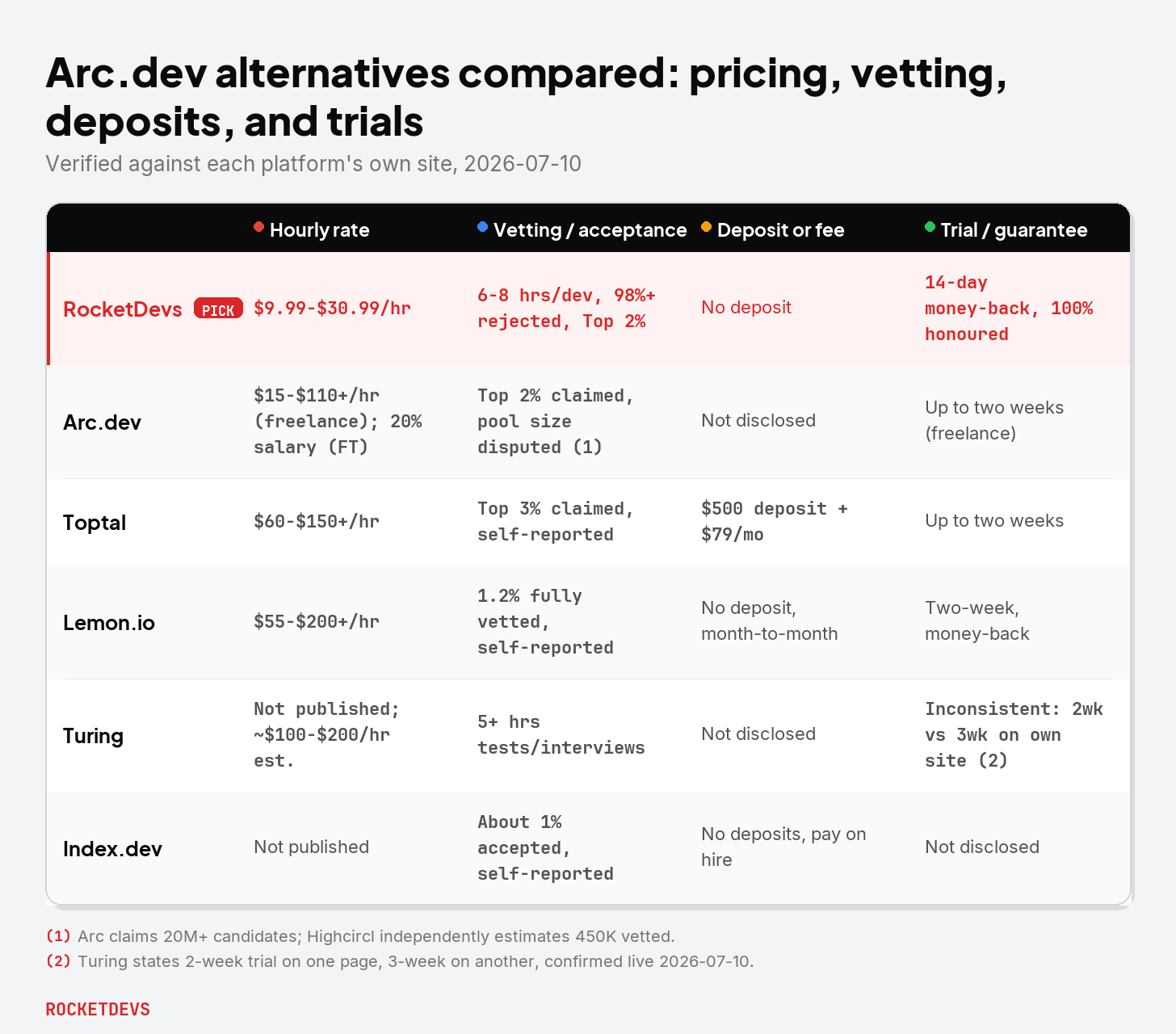
| Platform | Hourly rate | Vetting / acceptance | Deposit or fee | Trial / guarantee |
|---|---|---|---|---|
| RocketDevs | $9.99/hr (Associate), $21.99/hour (Mid-senior), $30.99/hour (Senior) | 6-8 hours per developer, 98%+ rejection rate, Top 2% acceptance | No deposit | 14-day money-back, 100% honoured |
| Arc.dev | $15-$110+/hour (freelance); 20% of annual salary (full-time) | AI-matching against a stated 20M+ candidate pool; a top-2% acceptance rate is claimed per an independent estimate | Not disclosed on Arc's own site | Up to two weeks (freelance) |
| Toptal | $60-$150+/hour (specialist rates to $200+/hour), per independent sources | Toptal states "top 3%" acceptance on its own site | $500 refundable deposit plus $79/month subscription, per independent sources | Up to two weeks, per Toptal's own trial-based model |
| Lemon.io | $55-$200+/hour depending on seniority, per Lemon.io's own site | Lemon.io states 1.2% reach full vetting and onboarding | No deposit disclosed; month-to-month billing | Two-week trial, money-back guarantee |
| Turing | Not published by Turing; roughly $100-$200/hour per an independent estimate | Turing describes 5+ hours of tests and interviews per candidate | Not disclosed | Turing states "3-week free trial" in one section and "2-week free trial" in its own FAQ |
| Index.dev | Not published by Index.dev in this sweep | Index.dev states "only 1% of engineers make it into our network" | No retainers, no deposits, no search fees, per Index.dev's own site | Not disclosed on Index.dev's own site |
Hourly rate
What we can glean from this table is that Toptal is by far the most expensive at $60 - $150 per hour, and $200 for specialists. This hourly rate dwarves RocketDevs at $9.99 an hour for an associate, $21.99 per hour for a mid-senior and $30.99 for a senior developer. Lemon.io charges $55-200 depending on the seniority of the position. At the time of the writing of this blog, Turing and Index.dev have not published their hourly rate, but per an independent estimate Turing's prices are roughly between $100 and $200 per hour.
Vetting/ acceptance
Vetting standards vary widely between developer hiring platforms, but they all aim to solve the same problem: ensuring employers only meet highly qualified candidates. The difference lies in how much time each platform spends evaluating developers and how selective its acceptance process is.
RocketDevs reports spending 6-8 hours vetting each developer, rejecting more than 98% of applicants and accepting only the top 2% into its network. Arc.dev uses AI to match companies with developers from a claimed pool of more than 20 million candidates, while independent estimates suggest it also maintains a top 2% acceptance rate. Toptal states that it accepts only the top 3% of applicants. Lemon.io reports that just 1.2% of developers complete its full vetting and onboarding process. Turing says every candidate completes more than five hours of tests and interviews, while Index.dev states that only 1% of engineers are accepted into its network.
Based on these published figures, RocketDevs stands out for combining one of the longest reported vetting processes with one of the most selective acceptance rates. Index.dev and Lemon.io are similarly selective, while Toptal also maintains a highly competitive acceptance rate. Arc.dev's strength lies in pairing AI-powered matching with a large talent pool, and Turing emphasizes extensive technical testing. Ultimately, the best platform depends on what a company values most, but if rigorous manual vetting and selectivity are the priority, RocketDevs presents one of the strongest screening processes among the platforms compared.
Deposit or fee
The upfront cost of hiring through a developer marketplace can vary considerably. Some platforms require a financial commitment before you even begin evaluating candidates, while others allow companies to start hiring without paying a deposit or retainer.
RocketDevs does not require an upfront deposit, allowing businesses to begin the hiring process without an initial financial commitment. Arc.dev does not disclose any deposit requirements on its website. According to independent sources, Toptal requires a refundable $500 deposit before matching candidates, along with a $79 monthly subscription fee. Lemon.io does not disclose an upfront deposit and instead operates on a month-to-month billing model, giving businesses greater flexibility. Turing does not publicly disclose any deposit or retainer requirements. Index.dev states that it charges no retainers, no deposits, and no search fees, allowing companies to hire without upfront costs.
For companies looking to minimise upfront hiring costs, RocketDevs and Index.dev offer the most transparent and accessible pricing models based on the information available, as both explicitly state that they do not charge deposits or retainers. Lemon.io also provides a low-commitment option through its month-to-month billing model. By contrast, Toptal requires an upfront deposit and an ongoing subscription, while Arc.dev and Turing do not publicly disclose whether deposits or retainers apply, making it more difficult for businesses to compare total hiring costs in advance.
Trial/ guarantee
A trial period or hiring guarantee can reduce the risk of bringing on a new developer, giving companies time to confirm that the match is right before making a long-term commitment. While most developer hiring platforms offer some form of trial, the length and terms vary.
RocketDevs offers a 14-day money-back guarantee, which it states has been 100% honoured for eligible cases. Arc.dev provides up to a two-week trial for freelance hires. Toptal also offers up to a two-week trial as part of its trial-based hiring model. Lemon.io includes a two-week trial backed by a money-back guarantee. Turing's website contains inconsistent information, stating a three-week free trial in one section and a two-week free trial in its FAQ. Index.dev does not disclose a trial period or hiring guarantee on its website.
Based on the published information, RocketDevs, Toptal, Lemon.io, and Arc.dev all offer comparable trial periods of around two weeks, helping businesses assess a developer before committing. RocketDevs distinguishes itself by publicly stating that its 14-day money-back guarantee has been 100% honoured, providing an additional level of reassurance. Turing also offers a trial, although the conflicting information on its website makes the exact duration unclear, while Index.dev does not publicly advertise a trial or guarantee.
How does RocketDevs compare more broadly?
Among the leading Arc.dev alternatives, RocketDevs offers one of the most founder-friendly hiring models. Like Toptal, it accepts only a small percentage of applicants, with more than 98% of developers rejected during a multi-stage technical and communication vetting process. Unlike Arc.dev, Turing, and Index.dev, which primarily focus on matching candidates and leave more of the final evaluation to employers, RocketDevs places greater emphasis on pre-vetting talent before candidates ever reach a client. It also differs from platforms such as Toptal and Lemon.io by requiring no upfront deposit or subscription fee to begin hiring, reducing the financial commitment for early-stage startups. To further lower hiring risk, RocketDevs includes a trial period and replacement guarantee, allowing founders to assess a developer's real-world performance before making a long-term commitment. For startups that want thoroughly vetted developers without large upfront costs or lengthy recruitment cycles, RocketDevs provides one of the strongest overall alternatives to Arc.dev. Beyond this comparison, RocketDevs' full competitor breakdown covers the wider set of developer-hiring platforms founders evaluate.
What should you compare beyond the hourly rate?
Hourly rates are only one part of the cost of hiring a developer. To compare platforms fairly, founders should also consider upfront fees, hiring commitments, and how much of the screening process the platform handles.
Deposits and platform fees
Some platforms charge more than an hourly rate. For example, Toptal requires a refundable $500 deposit and charges a monthly subscription fee in addition to developer rates. By contrast, both RocketDevs and Index.dev state that they do not charge deposits, retainers, or search fees, allowing startups to begin hiring without significant upfront costs. Even if two platforms advertise the same hourly rate, additional fees can make the total cost very different.
Full-time vs. freelance hiring
Not every platform follows the same hiring model. Arc.dev supports both freelance and full-time hiring, but the pricing differs. Freelance developers are billed hourly, while full-time hires incur a placement fee equal to 20% of the developer's annual salary. Lemon.io uses a different approach again, offering month-to-month freelance engagements with no long-term commitment or placement fee. These pricing models serve different hiring needs, so they should not be compared on hourly rates alone.
How much vetting does the platform handle?
One of the biggest differences between hiring platforms is who is responsible for evaluating candidates. According to an independent review by Highcircl, founders using Arc.dev may still spend 10-15 hours interviewing and screening AI-matched candidates. Toptal and Index.dev both advertise highly selective acceptance rates, although these figures have not been independently audited. RocketDevs takes a more hands-on approach by completing 6-8 hours of technical and communication vetting for every developer before introducing them to clients, rejecting more than 98% of applicants. For founders with limited time or technical expertise, the depth of a platform's vetting process can have as much impact as its pricing.
Which alternative fits which kind of founder?
- Strong internal technical screener, wants freelance flexibility. Arc.dev's speed or Lemon.io's month-to-month pricing, since both hand over a fast, reasonably screened shortlist and let the founder's team make the final call.
- Wants a brand-name platform, can absorb a deposit and monthly fee.Toptal's claimed top-3% bar and sub-24-hour matching, per Toptal's own site, for the price of $500 deposit and $79 monthly subscription.
- Wants the lowest-friction, no-deposit entry point. Index.dev, which states no retainers, deposits, or search fees on its own site, though it discloses the least about its own pricing here.
- Does not want to spend 10 to 15 hours screening a shortlist, wants a full-time hire with a published rate and no deposit. RocketDevs is built for exactly this: 6 to 8 hours of vetting per developer, a 98%+ rejection rate, Top 2% acceptance, entry pricing from $9.99/hr.
RocketDevs does the screening before you see a name
Most AI-powered hiring platforms follow a similar model: they use algorithms to quickly generate a shortlist of candidates, but the responsibility for verifying those candidates still falls largely on the founder. While AI can speed up talent discovery, it cannot fully assess:
- technical ability;
- communication skills;
- problem-solving;
- or reliability.
As a result, founders often spend significant time interviewing and evaluating candidates after receiving a shortlist.
RocketDevs takes a different approach. Instead of matching first and screening later, every developer is thoroughly vetted before they are ever introduced to a client. The process includes technical assessments, communication evaluations, and multiple stages of review that together take approximately 6 to 8 hours per candidate. More than 98% of applicants are rejected, leaving only the top 2% of developers available for hire.
This upfront vetting allows founders to spend less time filtering candidates and more time choosing between developers who have already met a high bar for quality. It also creates greater pricing transparency. RocketDevs publishes fixed hourly rates across experience levels:
- $9.99 per hour for Associate developers;
- $21.99 per hour for Mid-Senior developers;
- and $30.99 per hour for Senior developers.
Unlike some competitors, there are no deposits, retainers, or search fees, making it easier for startups to understand their hiring costs from the outset.
To further reduce hiring risk, RocketDevs offers a 14-day money-back trial that is fully honoured if the match is not right. For founders who want a hiring process that prioritizes vetting before matching, RocketDevs provides a more hands-on alternative to platforms that rely primarily on AI-generated shortlists. The result is a simpler promise: elite talent, transparent pricing, and less time spent screening candidates yourself.
Sources
- Arc.dev, own pricing page
- Arc.dev, own homepage
- Highcircl, "Arc.dev alternatives: when AI matching isn't enough," Marton Biro, April 15, 2026
- The Frontend Company, "Toptal Pricing: Hidden Fees, Total Cost and What to Expect," Alex Vasylenko, February 26, 2025
- HireInSouth, "How Much Does Toptal Cost in 2026?"
- Toptal, own homepage
- Lemon.io, own pricing page
- Lemon.io, own rate calculator
- Turing, own homepage
- Turing, own hire-remote-developers page
- HireInSouth, "Turing Pricing 2026"
- Index.dev, own homepage
- RocketDevs, own homepage
- RocketDevs, "Full Hiring Process Guide"
- RocketDevs, Pricing Page
James Hitch, COO at RocketDevs Last updated: 2026-07-09

Written by
James Hitch
COO
James Hitch is the COO of RocketDevs, where he runs sales, recruiting, and the vetting operation that accepts only the top 2–3% of developer applicants. He cares about putting accessible, elite engineering talent within reach of founders and startups worldwide, at a fair price. He writes about technical hiring, building AI-native engineering teams, and how startups can access elite developers affordably.
More from our blog
Continue exploring insights and stories from RocketDevs